The hurricane cancelled half of last week at the Met, but the dangling crane on 57th has forced a Carnegie Hall shutdown that's still ongoing. At least power and most of the subways are back in and around the venues...
Metropolitan Opera
Turandot (M/F), Tempest (T/SM), Figaro (W/SE), Ballo (Th)
David Alden's Ballo debuts, with an excellent cast and Luisi in the pit. You can see The Tempest on Election Day (and I may actually end up doing this) or at the moviecast this weekend. This incarnation of Turandot is pretty good for what it is; the Figaro isn't.
Avery Fisher Hall
Richard Tucker Gala (Sunday 6:30pm)
Along with this year's Tucker Award winner Ailyn Pérez (not yet much heard in the city), the lineup includes Abdrazakov & Borodina, Filianoti, Giordani, Finley, Hvorostovsky, and Schrott.
NYU Skirball Center
Vox 2012 (Th)
This year at the new opera showcase: bits of operas by John Zorn, Moto Osada, Christopher Weiss, Evan Meier, James Stepleton, and Osnat Netzer. Too bad it's up against the Ballo premiere!
UPDATE (misread my calendar last week...)
Frick Collection
Toby Spence recital (Sunday 5pm)
The British tenor makes his New York recital debut in a program of German lieder, capped off by Schumann's Dichterliebe.
Monday, November 05, 2012

Monday, October 29, 2012
The week in NY opera (Oct. 29-Nov. 4)
With Sandy approaching, who knows how many of these performances will actually take place?
Metropolitan Opera
Turandot (T/F), Tempest (W/SM), Figaro (SE)
Figaro (grossly mishandled by Robertson) was supposed to play tonight as well, but that's been cancelled. Turandot, whenever it manages to begin, will bring the company debut of this year's Met Council Finals sensation Janai Brugger. I meant to see The Tempest on Saturday, but Figaro left such a bad taste in my mouth that I skipped it. This week, perhaps, if the real-life tempest permits.
Carnegie Hall
Opera Lafayette L'invitation au Voyage (F)
Chamber vocal selections by this French-themed company based in DC; features soprano Emmanuelle de Negri, recently seen with William Christie's company in Atys and a Rameau double bill.
OT
Murray Perahia recital (F)
Classical/romantic program by the now-veteran classical/romantic pianist.
Metropolitan Opera
Turandot (T/F), Tempest (W/SM), Figaro (SE)
Figaro (grossly mishandled by Robertson) was supposed to play tonight as well, but that's been cancelled. Turandot, whenever it manages to begin, will bring the company debut of this year's Met Council Finals sensation Janai Brugger. I meant to see The Tempest on Saturday, but Figaro left such a bad taste in my mouth that I skipped it. This week, perhaps, if the real-life tempest permits.
Carnegie Hall
Opera Lafayette L'invitation au Voyage (F)
Chamber vocal selections by this French-themed company based in DC; features soprano Emmanuelle de Negri, recently seen with William Christie's company in Atys and a Rameau double bill.
OT
Murray Perahia recital (F)
Classical/romantic program by the now-veteran classical/romantic pianist.
Saturday, October 27, 2012
The replacement
Otello - Metropolitan Opera, 10/16/2012
Amonov, Fleming, Struckmann / Bychkov
After a dress rehearsal in which he was a bit cautious but in no particular distress, tenor Johan Botha fared poorly on Otello's opening night. His indisposition left him out of the remainder of the run -- except, perhaps, this afternoon's moviecast, surely a nerve-wracking return if it happens.
His replacement in the title role? A Russian from the Mariinsky: Avgust Amonov, who made his Met debut three days before this performance. Yes, he was pretty good. No, he's not the next _______. In fact, he (like Botha) is on the lyric side of the sing, with a nice basic sound in which one can hear the Bacchus he's sung elsewhere. But unlike Botha, Amonov doesn't have a big clarion ring to his lyric instrument, and the demands of Otello do restrict his colors and prevent big statements. Still, contrary to what you may have read elsewhere, it's a pleasant sound... or was on this night.
His other "unlike Botha"s may have been to his benefit. He's not a stand-and-sing paragraph phraser, but has some sense of dramatic character development even as a late cover. Definitely held up his end of the show, and an Otello I wouldn't mind seeing again given sufficiently good support.
Here Amonov had two amazing co-stars. Falk Struckmann seemed to me insufficiently menacing and impressive as Pizarro a dozen years back, but time has changed his capabilities. When he chews the scenery now as Iago, the vocal impact is as great as the dramatic -- and I'd love to hear his current incarnation as the Fidelio villain. Meanwhile Desdemona is still probably Renee Fleming's best operatic part, one in which she invariably finds her focus by Desdemona's great final double aria.
Bychkov's conducting depends on the moment: though he always seems to get the huge loud climaxes up, the material in between may be urgent or slack. This night, he was a bit of both, though the cast change may have thrown things off -- we'll see what happens this afternoon.
Elijah Moshinsky's revived production, like his Makropoulos Case last season and Queen of Spades the season before, brings into sharp relief the limitations of the current Gelb directorial stable.
Amonov, Fleming, Struckmann / Bychkov
After a dress rehearsal in which he was a bit cautious but in no particular distress, tenor Johan Botha fared poorly on Otello's opening night. His indisposition left him out of the remainder of the run -- except, perhaps, this afternoon's moviecast, surely a nerve-wracking return if it happens.
His replacement in the title role? A Russian from the Mariinsky: Avgust Amonov, who made his Met debut three days before this performance. Yes, he was pretty good. No, he's not the next _______. In fact, he (like Botha) is on the lyric side of the sing, with a nice basic sound in which one can hear the Bacchus he's sung elsewhere. But unlike Botha, Amonov doesn't have a big clarion ring to his lyric instrument, and the demands of Otello do restrict his colors and prevent big statements. Still, contrary to what you may have read elsewhere, it's a pleasant sound... or was on this night.
His other "unlike Botha"s may have been to his benefit. He's not a stand-and-sing paragraph phraser, but has some sense of dramatic character development even as a late cover. Definitely held up his end of the show, and an Otello I wouldn't mind seeing again given sufficiently good support.
Here Amonov had two amazing co-stars. Falk Struckmann seemed to me insufficiently menacing and impressive as Pizarro a dozen years back, but time has changed his capabilities. When he chews the scenery now as Iago, the vocal impact is as great as the dramatic -- and I'd love to hear his current incarnation as the Fidelio villain. Meanwhile Desdemona is still probably Renee Fleming's best operatic part, one in which she invariably finds her focus by Desdemona's great final double aria.
Bychkov's conducting depends on the moment: though he always seems to get the huge loud climaxes up, the material in between may be urgent or slack. This night, he was a bit of both, though the cast change may have thrown things off -- we'll see what happens this afternoon.
Elijah Moshinsky's revived production, like his Makropoulos Case last season and Queen of Spades the season before, brings into sharp relief the limitations of the current Gelb directorial stable.
You blew it up!
Le Nozze di Figaro - Metropolitan Opera, 10/26/2012
Abdrazakov, Erdmann, Kovalevska, Schäfer, Finley / Robertson
Wait, no joke? The Met managed to ruin Figaro? Seriously!?
Yep. I hadn't thought it possible. Jonathan Miller's production debuted with James Levine and an all-star cast, but quickly adapted to all sorts of personnel. Big names, small names, Levine, not Levine, the show rolled on. (Best Figaro: probably Furlanetto. Best non-Levine conductor: undoubtedly Edo de Waart.) But not this time. David Robertson is finally the conductor who makes nonsense from Mozart's sense, intentionally removing all traces of breath, sentiment, line, reflection, rapture, and, well, anything besides an endless monotonous chugging-forward from the piece. At this point it's impossible to get the Met Orchestra to sound bad in this material, but Robertson turns what should be the ebb and flow of feeling into sonic cacophony. I was initially inclined to point fingers at Gregory Keller's unsubtle stage direction and Christine Schäfer's bizarrely grim and glum Cherubino, but by the end I wondered if they were just trying to keep up with the pit's insanity. Mojca Erdmann (the second Lulu in the cast!) is miscast -- Susanna repeatedly hits the sour part of her voice -- but the rest of the cast was quite good... given what they had to work with. I'm amazed that Ildar Abdrazakov kept up with the silly, breathless tempi Robertson set in his last-act aria.
Ensembles also seemed under-rehearsed, but from all evidence that's not going to fix Robertson's anti-Mozartean pit work. He makes Mozart boring. Avoid.
Abdrazakov, Erdmann, Kovalevska, Schäfer, Finley / Robertson
Wait, no joke? The Met managed to ruin Figaro? Seriously!?
Yep. I hadn't thought it possible. Jonathan Miller's production debuted with James Levine and an all-star cast, but quickly adapted to all sorts of personnel. Big names, small names, Levine, not Levine, the show rolled on. (Best Figaro: probably Furlanetto. Best non-Levine conductor: undoubtedly Edo de Waart.) But not this time. David Robertson is finally the conductor who makes nonsense from Mozart's sense, intentionally removing all traces of breath, sentiment, line, reflection, rapture, and, well, anything besides an endless monotonous chugging-forward from the piece. At this point it's impossible to get the Met Orchestra to sound bad in this material, but Robertson turns what should be the ebb and flow of feeling into sonic cacophony. I was initially inclined to point fingers at Gregory Keller's unsubtle stage direction and Christine Schäfer's bizarrely grim and glum Cherubino, but by the end I wondered if they were just trying to keep up with the pit's insanity. Mojca Erdmann (the second Lulu in the cast!) is miscast -- Susanna repeatedly hits the sour part of her voice -- but the rest of the cast was quite good... given what they had to work with. I'm amazed that Ildar Abdrazakov kept up with the silly, breathless tempi Robertson set in his last-act aria.
Ensembles also seemed under-rehearsed, but from all evidence that's not going to fix Robertson's anti-Mozartean pit work. He makes Mozart boring. Avoid.
Wednesday, October 24, 2012
Deliver me
(Verdi) Requiem - Philadelphia Orchestra, 10/23/2012
Poplavskaya, Rice, Villazon, Petrenko / Nézet-Séguin
James Levine, Renee Fleming, Olga Borodina, Marcello Giordani, Rene Pape, and the Met Orchestra and Chorus performed this piece a dozen seasons ago at Carnegie Hall (the afternoon of April 29, 2001) -- an orchestral show not, in my concertgoing, equaled since. Last night wasn't that, but it was definitely something.
Verdi's Requiem Mass, ostensibly for Alessandro Manzoni, capped off the composer's great mature run of operas, which gave us an amazing string of dramatic masterworks -- Boccanegra, Ballo, Forza, and Don Carlos -- in succession before closing with two odd works, Aida and this sacred piece. In fact Aida is probably the less dramatic of the pair: true to its dream of old monumental Egypt, the opera's characters can hardly even consider struggling as events roll to implacable doom, instead reflecting and lyrically responding to the spectacle as it proceeds. Within the Requiem, it's true, the solo singers have lost names & histories, and are dwarfed by contact with the limitless. But Christianity is and has, in a way likely unprecedented, been fundamentally concerned with the event -- and not just the ritually recreated & celebrated event(s) of its founding, as most religions are, but the ever-newly-enacted event of each individual soul's salvation/damnation. Even at the final, most hapless moment -- the day of judgment -- we are not (Calvinists aside) in a ritual roll-call but at the end of a live event, full of dramatic emotions and disruptions and the echo of decisive struggles.
Verdi seizes on this essential kernel to set the grandest of his great dramatic scenes: the Sequentia (Dies Irae), the heart and longest part of this piece. It is great and grand and terrible, but also endlessly personal, the close of each individual soul's event&story. And so in the greatest performances we hear the irreducible impassioned individuality of the solo voices as they move through those familiar Verdian turns...
On this night, only soprano Marina Poplavskaya's instrument carried this kind of charge. For all my complaints about her Met ubiquity and sometimes-infuriating humorlessness, Poplavskaya certainly has the tools -- musicality, sonic scale, a range of dark and cutting tones -- to make much of a dead-serious part like this one (or Elisabetta): and she did, lack of warmth and some imperfect top notes (she actually had to cancel the first Philadelphia performance due to illness) notwithstanding. Mezzo Christine Rice and bass Mikhail Petrenko have very nice, well-groomed voices, but didn't deliver much beyond that.
The most famous of the soloists was probably the worst. Rolando Villazon almost crashed on the very first line of the "Ingemisco", was missing and sliding around between pitches all over the place, and generally sounded like he'd patched together fragments totaling maybe 2/3 of a tenor voice: most of the bottom, not much of the top (which was never, volume-wise, a strength), and danger in between. The singer once notable for exquisite breath and control is still in a sad form to witness.
But the evening was Nézet-Séguin's (or, as the program notes would have it, "Yannick's" -- understandable given pronunciation issues). If his conception lacked some of the life-and-death urgency and particularized detail certain of his elders have brought (and perhaps the good-but-not-great solo lineup was significant), it nevertheless astounded by its coherence and sonic & conceptual clarity. The audience responded with rapt silence through the end and terrific enthusiasm afterward.
It's the same story as Nézet-Séguin's Met debut Carmen: I can't wait to hear what he does with this stuff both now and over the years.
Poplavskaya, Rice, Villazon, Petrenko / Nézet-Séguin
James Levine, Renee Fleming, Olga Borodina, Marcello Giordani, Rene Pape, and the Met Orchestra and Chorus performed this piece a dozen seasons ago at Carnegie Hall (the afternoon of April 29, 2001) -- an orchestral show not, in my concertgoing, equaled since. Last night wasn't that, but it was definitely something.
Verdi's Requiem Mass, ostensibly for Alessandro Manzoni, capped off the composer's great mature run of operas, which gave us an amazing string of dramatic masterworks -- Boccanegra, Ballo, Forza, and Don Carlos -- in succession before closing with two odd works, Aida and this sacred piece. In fact Aida is probably the less dramatic of the pair: true to its dream of old monumental Egypt, the opera's characters can hardly even consider struggling as events roll to implacable doom, instead reflecting and lyrically responding to the spectacle as it proceeds. Within the Requiem, it's true, the solo singers have lost names & histories, and are dwarfed by contact with the limitless. But Christianity is and has, in a way likely unprecedented, been fundamentally concerned with the event -- and not just the ritually recreated & celebrated event(s) of its founding, as most religions are, but the ever-newly-enacted event of each individual soul's salvation/damnation. Even at the final, most hapless moment -- the day of judgment -- we are not (Calvinists aside) in a ritual roll-call but at the end of a live event, full of dramatic emotions and disruptions and the echo of decisive struggles.
Verdi seizes on this essential kernel to set the grandest of his great dramatic scenes: the Sequentia (Dies Irae), the heart and longest part of this piece. It is great and grand and terrible, but also endlessly personal, the close of each individual soul's event&story. And so in the greatest performances we hear the irreducible impassioned individuality of the solo voices as they move through those familiar Verdian turns...
On this night, only soprano Marina Poplavskaya's instrument carried this kind of charge. For all my complaints about her Met ubiquity and sometimes-infuriating humorlessness, Poplavskaya certainly has the tools -- musicality, sonic scale, a range of dark and cutting tones -- to make much of a dead-serious part like this one (or Elisabetta): and she did, lack of warmth and some imperfect top notes (she actually had to cancel the first Philadelphia performance due to illness) notwithstanding. Mezzo Christine Rice and bass Mikhail Petrenko have very nice, well-groomed voices, but didn't deliver much beyond that.
The most famous of the soloists was probably the worst. Rolando Villazon almost crashed on the very first line of the "Ingemisco", was missing and sliding around between pitches all over the place, and generally sounded like he'd patched together fragments totaling maybe 2/3 of a tenor voice: most of the bottom, not much of the top (which was never, volume-wise, a strength), and danger in between. The singer once notable for exquisite breath and control is still in a sad form to witness.
But the evening was Nézet-Séguin's (or, as the program notes would have it, "Yannick's" -- understandable given pronunciation issues). If his conception lacked some of the life-and-death urgency and particularized detail certain of his elders have brought (and perhaps the good-but-not-great solo lineup was significant), it nevertheless astounded by its coherence and sonic & conceptual clarity. The audience responded with rapt silence through the end and terrific enthusiasm afterward.
It's the same story as Nézet-Séguin's Met debut Carmen: I can't wait to hear what he does with this stuff both now and over the years.
Monday, October 22, 2012
The week in NY opera (October 22-28)
Nothing tonight, but tomorrow is one of those evenings in NYC where too many things happen at once.
Metropolitan Opera
Tempest (T/SE), Trovatore (Th), Figaro (F), Otello (SM)
Short week, perhaps because of two productions beginning: The Tempest, in its house premiere, and Figaro, featuring Ildar Abdrazakov and perhaps the only real lyric soprano cultivated during Gelb's tenure -- Maija Kovalevska. Meanwhile Trovatore wraps up its fall run (it returns in January with a wholly different lineup of singers), and the moviecast Otello gives Johan Botha one last shot at recovering from his illness...
Carnegie Hall
Philadelphia Orchestra concert (T)
Gabriel Kahane concert (Th)
Marlis Petersen recital (F)
Call me a reactionary, but Yannick Nézet-Séguin's first Carnegie show as Philly's music director -- Verdi's Requiem, no less -- seems more tempting than the first of many Met evenings of The Tempest. But is Villazon seriously going to sing it? Composer/songwriter/performer Gabe Kahane has a classical/hipster pop show at Zankel Thursday, while the very German soprano Marlis Petersen offers a recital themed on Goethe's Faust the following evening at Weill.
Le Poisson Rouge
Metropolis Ensemble concert (T)
An Evening with Thomas Ades and "The Tempest" (F 6:30pm and 9pm)
The former show features a mini-opera on Tesla, a rearrangement of Berlioz's Nuits d’Ete sung by Keira Duffy, and a new song-cycle by Mohammed Fairouz sung by Kate Lindsey. Lindsey returns Friday, joined by the composer/conductor of and singers from the Met's Tempest, for a remix on the opera and other Shakespeare-themed stuff.
Metropolitan Opera
Tempest (T/SE), Trovatore (Th), Figaro (F), Otello (SM)
Short week, perhaps because of two productions beginning: The Tempest, in its house premiere, and Figaro, featuring Ildar Abdrazakov and perhaps the only real lyric soprano cultivated during Gelb's tenure -- Maija Kovalevska. Meanwhile Trovatore wraps up its fall run (it returns in January with a wholly different lineup of singers), and the moviecast Otello gives Johan Botha one last shot at recovering from his illness...
Carnegie Hall
Philadelphia Orchestra concert (T)
Gabriel Kahane concert (Th)
Marlis Petersen recital (F)
Call me a reactionary, but Yannick Nézet-Séguin's first Carnegie show as Philly's music director -- Verdi's Requiem, no less -- seems more tempting than the first of many Met evenings of The Tempest. But is Villazon seriously going to sing it? Composer/songwriter/performer Gabe Kahane has a classical/hipster pop show at Zankel Thursday, while the very German soprano Marlis Petersen offers a recital themed on Goethe's Faust the following evening at Weill.
Le Poisson Rouge
Metropolis Ensemble concert (T)
An Evening with Thomas Ades and "The Tempest" (F 6:30pm and 9pm)
The former show features a mini-opera on Tesla, a rearrangement of Berlioz's Nuits d’Ete sung by Keira Duffy, and a new song-cycle by Mohammed Fairouz sung by Kate Lindsey. Lindsey returns Friday, joined by the composer/conductor of and singers from the Met's Tempest, for a remix on the opera and other Shakespeare-themed stuff.
Monday, October 15, 2012
The week in NY opera (October 15-21)
Metropolitan Opera
Carmen (M/Th), Otello (T/SM), Trovatore (W/SE)
It's the last week for the current cast in Carmen -- the excellent Yonghoon Lee, the not-so-excellent Kate Royal, and the mostly-excellent Kyle Ketelsen all are gone when the show returns in February. Trovatore should also be good. Tomorrow is the last weeknight performance of Otello with the current cast.
Link for weekend ticket lottery drawing here; enter by midnight ET.
Carnegie Hall
World Orchestra for Peace Solti centennial concert (F)
It is, I think, entirely appropriate in its irony that an body called the "World Orchestra for Peace" will be conducted by the music world's most shameless Putin bootlicker, last seen celebrating the Russian invasion of Georgia. If your nose doesn't register such stenches, Angela Gheorghiu and Rene Pape offer delicacies for the ear.
Alice Tully Hall
Les Arts Florissants Charpentier motets (F)
William Christie's company offers, this time, not opera but French baroque sacred pieces.
Carmen (M/Th), Otello (T/SM), Trovatore (W/SE)
It's the last week for the current cast in Carmen -- the excellent Yonghoon Lee, the not-so-excellent Kate Royal, and the mostly-excellent Kyle Ketelsen all are gone when the show returns in February. Trovatore should also be good. Tomorrow is the last weeknight performance of Otello with the current cast.
Link for weekend ticket lottery drawing here; enter by midnight ET.
Carnegie Hall
World Orchestra for Peace Solti centennial concert (F)
It is, I think, entirely appropriate in its irony that an body called the "World Orchestra for Peace" will be conducted by the music world's most shameless Putin bootlicker, last seen celebrating the Russian invasion of Georgia. If your nose doesn't register such stenches, Angela Gheorghiu and Rene Pape offer delicacies for the ear.
Alice Tully Hall
Les Arts Florissants Charpentier motets (F)
William Christie's company offers, this time, not opera but French baroque sacred pieces.
Sunday, October 14, 2012
The standard
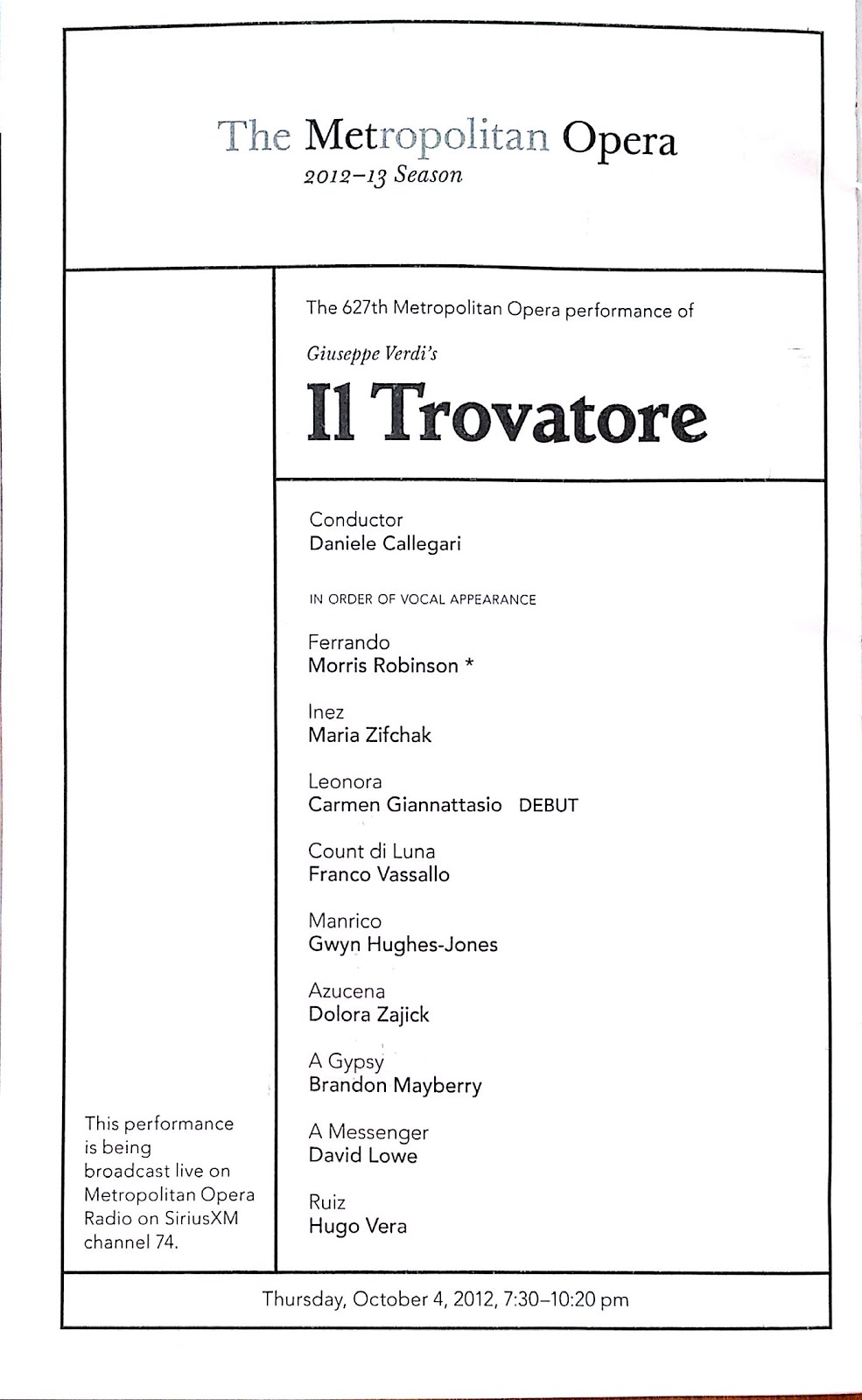
Jones, Giannattasio, Zajick, Vassallo, Robinson / Callegari
The premiere of McVicar's Trovatore at the Met had big stars; this revival lacked them, to the point of serious box office impairment. But the result this time reflected pretty well on the standards of the house even on lesser-name evenings.
Most impressive may have been baritone Franco Vassallo. I was decidedly unimpressed by his Belcore four seasons back, but his di Luna presented him in a totally different light. In fact, between his naturally robust sound, straightforward engagement in the character's villainy, and facility for both the lyric and declamatory sides of his music, Vassallo may have been the best di Luna I've seen in this production, outdoing both Hvorostovsky (intense but vocally taxed) and Lucic (alternately too lyric and not lyric enough).
Welsh tenor Gwyn Hughes Jones and Italian soprano Carmen Giannattasio had, depending on how you cared to look at it, either complementary strengths or complementary weaknesses. Jones gave basically a brighter-voiced version of Marcelo Alvarez's production-opening performance: intensely satisfying in the lyric and conversational portions of the role (thanks to a feel for the Verdian phrase that also served him well in ensembles), but lacking at climaxes. For Alvarez these punctuating high notes weren't easily reached; for Jones they just lacked force, particularly compared to his partners. How I would have liked him to break from expectation and sing both verses of "Di quella pira", giving pleasure more in the phrasing than in the obligatory high note... instead, of course, he sang one hasty verse before an impressively long but unimpressive-sounding high-note finish, the tone of which actually got away from him at the end.
Giannattasio does not lack for volume or high-note resonance: in fact her voice may rival Sondra Radvanovsky's wondrous instrument in natural scale. Just hearing her pop off big ensemble-capping high notes is a pleasure... but what leads up to that point is less exciting. She is not quite finished, both vocally (not entirely even in sound from top to bottom, still -- like most young singers -- unwilling to use chest voice) and musically, where she really could not compare to Jones. ("D'amor sull'ali rosee" was quite spoiled by her letting the end of each phrase sag.) The raw material for an excellent Verdi soprano is certainly there: besides the size and volume, she has a natural liquid flexibility that makes the cabalettas natural fodder. But she won Operalia a decade ago, has had major engagements for years and years, and though 34 isn't old, it's old enough to wonder if how and when she might make the last, oh-so-important refinements to turn her from a case of infuriatingly underutilized potential into a major and indispensable star.
Though she was, I believe, scheduled to debut the first week, this second performance of Trovatore turned out to be Gianattasio's debut -- perhaps this (or whatever caused the initial cancellation) affected her performance? In any case she seemed quite moved at her very positive curtain call reception (though perhaps she's a better actress in real life than Paula Williams' revival stage direction -- which put Gianattasio through McVicar's familiar postures for Leonora but had/let her recast them as hesitant instead of decisive -- let her express)...
Dolora Zajick of course carries over not only from the premiere of this production but from many years of false starts before that when casting anyone but Azucena properly seemed unlikely. The 2009 premiere found her showing, perhaps for the first time, some age: this revival finds her having adapted well to the years' changes. Her singing is again clear throughout, with no fraying tone to be heard, and if it's lightened a bit on top, the chest still hits with massive force.
Morris Robinson is a forceful -- if not dramatically onrushing -- Ferrando. Daniele Callegari conducts with a nice overall sweep and some fine ideas that may come to fruition later in the run -- when the ensemble hiccups that popped up in the show's second half will presumably have been exorcised. This same basic cast, with Chinese soprano Guanqun Yu in place of Giannattasio, has a few more peformances this month. Certainly worth catching.
Every good performance, like this one, convinces me a bit more that Il Trovatore is the most indispensable of operas. As I wrote after the premiere,
Verdi's much-derided opera has brothers, lovers, and a mother, but lacks one of his most persistent figures: the father. Whether divided and beset as in Rigoletto (both he and Monterone), stylish and daring (and metaphorical) as in Ballo, all-too-solid as in Traviata, or -- well, one could go on indefinitely -- the father sets the tone for his opera's world. Here, in Trovatore's story, he is wholly absent: dead of heartbreak, overthrown (in a sense) long ago by gypsy machinations. And so too in the piece itself: gone is the responsible worldly figure that makes our daylight world what it is -- ordered; rationally explainable and advancing; free from witchcraft, ghosts, and meaningful coincidence. But it is not just the shadowier stuff that he keeps off, but the oldest magics: rhythm - story - sacrifice. So here Verdi unleashes them all as no other could -- and too few since have at all dared to try -- for a nap-of-reason draught more intoxicating even than its near-contemporary Tristan's.An art incapable of such a potent, primeval draught seems hardly worth the trouble.
Friday, October 12, 2012
Return
The long post below alludes to it, but I should mention it as news: according to the Met, James Levine will conduct the orchestra again in May and three productions (Falstaff, Cosi, and Wozzeck -- three of his greatest pieces) next season.
Fingers crossed, knock on wood, etc.
Fingers crossed, knock on wood, etc.
Met season preview, part 3: life without
It is not a bad season -- to look at before the fact, anyway. But the most significant thing about the Metropolitan Opera's 2012-2013 is likely to be the most significant thing about its 2011-2012: the absence of James Levine.
A year ago the news came as... news, and in stages: a foretaste in spring, from the usual on-and-off issues; then the awful accident and cancellations for the first part of 2011-2012 in September; then the thud of no appearances at all. For many months -- until the announcement just last night of an eventual return, in fact -- Levine's absence has been the unspoken cloud hanging over the house. Fabio Luisi was appointed principal conductor last season, so the facade of continuity remained. And yet...
The problem for Peter Gelb and the Met is that Levine's work and presence in the pit was the core of the company's identity for decades. Singers, productions, production fads, and even general managers came and went, relying on the musical-sonic foundation provided by Levine and the orchestra he built and polished over many consecutive seasons. And not just his colleagues: for regular Met-goers, Levine's performances of Mozart, Verdi, Wagner, and the modernists were a pleasure one could anticipate as well as savor every year -- the one part of the experience that would not fail.
Yet it's not that Gelb and his administration have handled this crisis poorly: Luisi is as distinguished an emergency deputy as one could imagine, and circumstance has parked Yannick Nézet-Séguin, the first really plausible successor I can recall, just down the Turnpike at the Philadelphia Orchestra. The house continues its decade-long trend of trying out interesting new conducting talent, though with mixed results. But Levine's presence has been particularly important to Gelb's administration, because Levine maintained in his domain virtues Gelb otherwise is and has been reluctant to offer and value: warmth, attention to beautiful sound per se, and -- of course -- Americanness.
For all Fabio Luisi's prodigious skill and clarity, he's not that kind of counterweight. Luisi is, in fact, exactly of a piece with the Gelb administration's favored artists: a bit cerebral, a bit chilly even in his excitement, and impeccably European in pedigree. His substitution for Levine has put us now thoroughly in the Gelb era.
* * *
It's perhaps not quite coincidence that dissatisfaction with Gelb's administration is now part of the operagoing air. Spring's Opera News kerfuffle aired the extent of this development: not only did the public roundly slam the Met, but the press as well, with hints that even Tommasini at the Times may be growing tired of carrying the company's water. Why? Well, I noted at the start of Gelb's tenure that he holds a specific and far-from-universal vision of opera, and subsequent years seem to have borne this out. One could recognize the family resemblance in his productions years ago: tall blank walls, high narrow staircases and platforms, dim lighting and strong colors, near-doctrinaire avoidance/elimination of representational detail (as in Islamic art, words and abstract designs are permitted) in sets though not in costumes, and of course a general tilt to the crass and vulgar in stage direction. (Some house edict seems to have extended the latter element to revivals as well, creating the Obligatory Gelb-Era Humping Scene.) This can be fantastic -- as in, most recently, The Nose -- and is catnip to a certain segment of New Yorkers, but is contrary to the way a large (perhaps majority) portion of the Met audience takes in and appreciates visual information. And yet the alternatives -- though ever more important, as the Met rolls out its biggest and most war-horsey traditional productions (Turandot and Aida) many times this season to weather the poor economy -- are vanishing faster than they used to, thanks to the uptick in (new, Gelb-style) premieres from Gelb's co-production program.
Even the shows seemingly designed for traditional appeal do not quite scratch that itch. For not only do Bart Sher's comedic efforts (his louche Hoffmann -- the one show where he wasn't tasked with aiming for faux-traditional -- was quite good, though very much in the Gelb-era manner) and the Lepage Ring -- the most prominent efforts in this vein -- largely remix the same anti-traditional visual syntax, they in fact rely on theatrical distancing effects (video screens, frames, play-within-a-play additions) that present the story under glass, or in big quotation marks. Straightforward warmth, beauty, realism still aren't on the table, and so as traditional experiences, these new shows fail where their predecessors (often) succeeded. (Of course, they don't succeed as critic-pleasing fare either, and I can almost imagine Gelb striding bloodily onto the stage demanding "Are you not entertained!?" at their premieres.)
Some form of this complaint is now regularly aired with each premiere. But the corresponding trend in casting has been less remarked upon. For while respecting the biggest stars already in the house, Gelb brought a certain kind of singer to the fore from the start, and continues to do so today. His original favorites have largely run their course: Angela Gheorghiu crashed and burned with this administration as she did with Volpe's, Diana Damrau has failed to become an audience draw despite much exposure and press, and while Anna Netrebko still sells tickets, she does so now more as an opera celebrity than as notable artist or (as silly as it is to mention) sex symbol. Behind them, though, the Met continues to bring in and promote sopranos in their mold -- e.g. Nino Machaidze, Hibla Gerzmava, and of course the now-ubiquitous Marina Poplavskaya. As much as I like these interesting East-European singers with interesting voices, it would be an awful loss if their virtues displaced the Levine characteristics I mentioned above -- warmth, attention to beautiful sound per se, and Americanness -- in this aspect of opera as well.
The Met is closer to this point than one might think, at least among sopranos. Look at Faust: yes, Gheorghiu's cancellation/firing left the house looking for a late replacement, but Marguerite is a, perhaps the lyric soprano part, one that any singer with a voice and an iota of charm should carry off. (The greatest success in recent memory was classic soubrette-stimmdiva Ruth Ann Swenson.) And yet the Met chose Poplavskaya -- for all her virtues, the seemingly least-charming singer on its roster, and one with a functional rather than beautiful tone -- and not only let her sink the new production last season, but engaged her to ensure this season's revival is just as much of a dud. Why? When so many lyric sopranos with the classic lyric soprano virtues are out there, it's hard not to see this as a deliberate sign of what the house values and intends to value. (One might also take Kate Royal's unpleasant to hear Micaela in this vein.)
(Met Council winners do seem to get a shot, though, so let's hope Susanna Phillips seizes her long-in-coming Donna Anna and Janai Brugger turns out to be a hit as Liu.)
* * *
It's possible, of course, that Levine will, as the Met just announced, return next season hale and strong enough to make this interregnum a distant and unfortunate memory. I certainly hope so -- and even reading of his eventual return has chased off some of the gloom that inspired this piece. But even with Levine in the pit and assuring the vitality of his house, the artistic one-sidedness of the elements outside his domain will, if it continues, continue to frustrate and limit its success. For Gelb's problem, with or without Levine, remains what I noted five-and-a-half years back: the art form exists and is enjoyed in too many different ways for a single approach to be enough. Gelb's single way has shown its limits, and yet is growing ever closer to swallowing every other path. What now? Well, if I were Gelb I would look to find new approaches, with a few more shots at a real, sincere traditionalism -- beginning with a replacement for the worst production in the repertory, the unwatchable Traviata. And I'd think more about presenting beautiful voices... and I'd make sure Nezet-Seguin learns the Verdi canon as fast as possible.
I'm pretty sure the latter will be covered -- as for the rest? Unlikely, but we'll see. As I said, dissatisfaction is in the air.
A year ago the news came as... news, and in stages: a foretaste in spring, from the usual on-and-off issues; then the awful accident and cancellations for the first part of 2011-2012 in September; then the thud of no appearances at all. For many months -- until the announcement just last night of an eventual return, in fact -- Levine's absence has been the unspoken cloud hanging over the house. Fabio Luisi was appointed principal conductor last season, so the facade of continuity remained. And yet...
The problem for Peter Gelb and the Met is that Levine's work and presence in the pit was the core of the company's identity for decades. Singers, productions, production fads, and even general managers came and went, relying on the musical-sonic foundation provided by Levine and the orchestra he built and polished over many consecutive seasons. And not just his colleagues: for regular Met-goers, Levine's performances of Mozart, Verdi, Wagner, and the modernists were a pleasure one could anticipate as well as savor every year -- the one part of the experience that would not fail.
Yet it's not that Gelb and his administration have handled this crisis poorly: Luisi is as distinguished an emergency deputy as one could imagine, and circumstance has parked Yannick Nézet-Séguin, the first really plausible successor I can recall, just down the Turnpike at the Philadelphia Orchestra. The house continues its decade-long trend of trying out interesting new conducting talent, though with mixed results. But Levine's presence has been particularly important to Gelb's administration, because Levine maintained in his domain virtues Gelb otherwise is and has been reluctant to offer and value: warmth, attention to beautiful sound per se, and -- of course -- Americanness.
For all Fabio Luisi's prodigious skill and clarity, he's not that kind of counterweight. Luisi is, in fact, exactly of a piece with the Gelb administration's favored artists: a bit cerebral, a bit chilly even in his excitement, and impeccably European in pedigree. His substitution for Levine has put us now thoroughly in the Gelb era.
It's perhaps not quite coincidence that dissatisfaction with Gelb's administration is now part of the operagoing air. Spring's Opera News kerfuffle aired the extent of this development: not only did the public roundly slam the Met, but the press as well, with hints that even Tommasini at the Times may be growing tired of carrying the company's water. Why? Well, I noted at the start of Gelb's tenure that he holds a specific and far-from-universal vision of opera, and subsequent years seem to have borne this out. One could recognize the family resemblance in his productions years ago: tall blank walls, high narrow staircases and platforms, dim lighting and strong colors, near-doctrinaire avoidance/elimination of representational detail (as in Islamic art, words and abstract designs are permitted) in sets though not in costumes, and of course a general tilt to the crass and vulgar in stage direction. (Some house edict seems to have extended the latter element to revivals as well, creating the Obligatory Gelb-Era Humping Scene.) This can be fantastic -- as in, most recently, The Nose -- and is catnip to a certain segment of New Yorkers, but is contrary to the way a large (perhaps majority) portion of the Met audience takes in and appreciates visual information. And yet the alternatives -- though ever more important, as the Met rolls out its biggest and most war-horsey traditional productions (Turandot and Aida) many times this season to weather the poor economy -- are vanishing faster than they used to, thanks to the uptick in (new, Gelb-style) premieres from Gelb's co-production program.
Even the shows seemingly designed for traditional appeal do not quite scratch that itch. For not only do Bart Sher's comedic efforts (his louche Hoffmann -- the one show where he wasn't tasked with aiming for faux-traditional -- was quite good, though very much in the Gelb-era manner) and the Lepage Ring -- the most prominent efforts in this vein -- largely remix the same anti-traditional visual syntax, they in fact rely on theatrical distancing effects (video screens, frames, play-within-a-play additions) that present the story under glass, or in big quotation marks. Straightforward warmth, beauty, realism still aren't on the table, and so as traditional experiences, these new shows fail where their predecessors (often) succeeded. (Of course, they don't succeed as critic-pleasing fare either, and I can almost imagine Gelb striding bloodily onto the stage demanding "Are you not entertained!?" at their premieres.)
Some form of this complaint is now regularly aired with each premiere. But the corresponding trend in casting has been less remarked upon. For while respecting the biggest stars already in the house, Gelb brought a certain kind of singer to the fore from the start, and continues to do so today. His original favorites have largely run their course: Angela Gheorghiu crashed and burned with this administration as she did with Volpe's, Diana Damrau has failed to become an audience draw despite much exposure and press, and while Anna Netrebko still sells tickets, she does so now more as an opera celebrity than as notable artist or (as silly as it is to mention) sex symbol. Behind them, though, the Met continues to bring in and promote sopranos in their mold -- e.g. Nino Machaidze, Hibla Gerzmava, and of course the now-ubiquitous Marina Poplavskaya. As much as I like these interesting East-European singers with interesting voices, it would be an awful loss if their virtues displaced the Levine characteristics I mentioned above -- warmth, attention to beautiful sound per se, and Americanness -- in this aspect of opera as well.
The Met is closer to this point than one might think, at least among sopranos. Look at Faust: yes, Gheorghiu's cancellation/firing left the house looking for a late replacement, but Marguerite is a, perhaps the lyric soprano part, one that any singer with a voice and an iota of charm should carry off. (The greatest success in recent memory was classic soubrette-stimmdiva Ruth Ann Swenson.) And yet the Met chose Poplavskaya -- for all her virtues, the seemingly least-charming singer on its roster, and one with a functional rather than beautiful tone -- and not only let her sink the new production last season, but engaged her to ensure this season's revival is just as much of a dud. Why? When so many lyric sopranos with the classic lyric soprano virtues are out there, it's hard not to see this as a deliberate sign of what the house values and intends to value. (One might also take Kate Royal's unpleasant to hear Micaela in this vein.)
(Met Council winners do seem to get a shot, though, so let's hope Susanna Phillips seizes her long-in-coming Donna Anna and Janai Brugger turns out to be a hit as Liu.)
It's possible, of course, that Levine will, as the Met just announced, return next season hale and strong enough to make this interregnum a distant and unfortunate memory. I certainly hope so -- and even reading of his eventual return has chased off some of the gloom that inspired this piece. But even with Levine in the pit and assuring the vitality of his house, the artistic one-sidedness of the elements outside his domain will, if it continues, continue to frustrate and limit its success. For Gelb's problem, with or without Levine, remains what I noted five-and-a-half years back: the art form exists and is enjoyed in too many different ways for a single approach to be enough. Gelb's single way has shown its limits, and yet is growing ever closer to swallowing every other path. What now? Well, if I were Gelb I would look to find new approaches, with a few more shots at a real, sincere traditionalism -- beginning with a replacement for the worst production in the repertory, the unwatchable Traviata. And I'd think more about presenting beautiful voices... and I'd make sure Nezet-Seguin learns the Verdi canon as fast as possible.
I'm pretty sure the latter will be covered -- as for the rest? Unlikely, but we'll see. As I said, dissatisfaction is in the air.
Monday, October 08, 2012
The week in NY opera (October 8-14)
Metropolitan Opera
Trovatore (M/F), Otello (T/SE), Elisir (W*/SM), Carmen (Th)
The big event is, of course, the return of Botha, Fleming, and Bychkov in an Otello that was one of the highlights five seasons back. Trovatore, despite its relatively no-name cast, is pretty good -- elaboration to follow.
Link for weekend ticket lottery drawing here; enter by midnight ET.
* Wednesday's (starred) Elisir is the one just before this Saturday's matinee moviecast, which means that the camera equipment and lights will be out in force. Do not sit in side orchestra, front orchestra, or side parterre -- the house is not interested in optimizing patron experience on these nights, but in making the eventual broadcast go well.
Carnegie Hall
Met Orchestra concert (Sunday 3pm)
Bychkov again, this time in Wagner and Strauss. Eva-Maria Westbroek sings the former's Wesendonck songs.
Trovatore (M/F), Otello (T/SE), Elisir (W*/SM), Carmen (Th)
The big event is, of course, the return of Botha, Fleming, and Bychkov in an Otello that was one of the highlights five seasons back. Trovatore, despite its relatively no-name cast, is pretty good -- elaboration to follow.
Link for weekend ticket lottery drawing here; enter by midnight ET.
* Wednesday's (starred) Elisir is the one just before this Saturday's matinee moviecast, which means that the camera equipment and lights will be out in force. Do not sit in side orchestra, front orchestra, or side parterre -- the house is not interested in optimizing patron experience on these nights, but in making the eventual broadcast go well.
Carnegie Hall
Met Orchestra concert (Sunday 3pm)
Bychkov again, this time in Wagner and Strauss. Eva-Maria Westbroek sings the former's Wesendonck songs.
Monday, October 01, 2012
The week in NY opera (October 1-7)
Metropolitan Opera
Elisir (M/F), Carmen (T/SE), Turandot (W/SM), Trovatore (Th)
Same shows as last week. Carmen is good. Trovatore, which is hideously undersold and lacks star casting, at least has an excellent recent production.
Link for weekend ticket lottery drawing here; enter by midnight ET.
Le Poisson Rouge
Gotham Chamber Opera: Orientale (M/W)
A baroque-romantic-exotic traditional music/multimedia mashup.
Alexander Kasser Theater (Montclair State University)
Dog Days (F/S/SuM)
I feel a bit bad about not seeing or mentioning the premiere of this show last weekend, but the new opera by David T. Little and librettist Royce Vavrek plays again this week. The trailer below may help you judge for yourself whether it may merit an out-of-town trip (bus service does run from Port Authority):
Elisir (M/F), Carmen (T/SE), Turandot (W/SM), Trovatore (Th)
Same shows as last week. Carmen is good. Trovatore, which is hideously undersold and lacks star casting, at least has an excellent recent production.
Link for weekend ticket lottery drawing here; enter by midnight ET.
Le Poisson Rouge
Gotham Chamber Opera: Orientale (M/W)
A baroque-romantic-exotic traditional music/multimedia mashup.
Alexander Kasser Theater (Montclair State University)
Dog Days (F/S/SuM)
I feel a bit bad about not seeing or mentioning the premiere of this show last weekend, but the new opera by David T. Little and librettist Royce Vavrek plays again this week. The trailer below may help you judge for yourself whether it may merit an out-of-town trip (bus service does run from Port Authority):
Saturday, September 29, 2012
Slow burn
Carmen - Metropolitan Opera, 9/28/2012
Rachvelishvili, Royal, Lee, Ketelsen / Mariotti
Leads Anita Rachvelishvili and Yonghoon Lee are, it turns out, who we thought they were: a pair of astonishing-voiced singers who can carry any production. Rachvelishvili still hits some pitch issues at the top of her range, but the main body of her sound is as fully and gorgeously textured as any mezzo in this Golden Age. Lee, meanwhile, shows here as strongly as he did as Don Carlo that he's something like an ideal romantic spinto tenor: he feels -- and of course shapes -- these parts' great tragic phrases so strongly, so grandly, that the striking squillo of his tone and the full expansiveness of his high notes come almost as obvious corollaries. More, please.
The other headliners were mixed. Best was American bass-baritone Kyle Ketelsen, who in addition to being an appropriately handsome Escamillo was the most vocally authoritative one since Rene Pape about a decade ago. Less good was the Micaela, Kate Royal. She phrased just fine, but even a vibrato-aficionado as I -- Calleja, Radvanovsky, and Röschmann may be my favorite operatic sounds -- found little to enjoy in Royal's actual singing. Unlike these other vibrati, Royal's does not seem the healthy individual expression of a strong support, but something less felicitous. I hope she's indisposed or not entirely recovered from her last pregnancy or... something, because otherwise I'm concerned for the state of English ears. Her sound did not blend at all well with Lee's, but that at least makes a sort of dramatic sense.
Debuting conductor Michele Mariotti was somewhere in between. The current principal conductor at Bologna showed a number of virtues: precise control of ensembles, firm rhythmic sense, and the wisdom not to get in his singers' way -- and, indeed, helping them make much of slow climaxes of the piece. And so on this night the highlights were the Micaela-Jose duet, the Flower Song, and similar still segments throughout, here done with a rare unity and concentration. But despite all that -- and despite fairly snappy accounts of the first- and last-act preludes -- Mariotti seemed to have little interest in giving the piece an overall shape, quite happy to let the colorful bits slack unhurriedly, as if in fact on a hot Spanish afternoon, and to let the more urgent portions approach but never quite cross over into excitement. This appears to be Mariotti's legitimate view of the piece, and he shows skill in bringing it to life, but it's a letdown after how Nézet-Séguin opened the production three seasons back.
So the show falls into scenes, which is not the worst thing given the way its cast brings them successively to life.
* * *
Lee will, it seems, be back in the not-too-distant future for revivals of Ballo (new later this season) and Trovatore. In this interview from last year (around the Nabucco revival) one can see him talk about the time before his big break: fascinating stuff.
Rachvelishvili, Royal, Lee, Ketelsen / Mariotti
Leads Anita Rachvelishvili and Yonghoon Lee are, it turns out, who we thought they were: a pair of astonishing-voiced singers who can carry any production. Rachvelishvili still hits some pitch issues at the top of her range, but the main body of her sound is as fully and gorgeously textured as any mezzo in this Golden Age. Lee, meanwhile, shows here as strongly as he did as Don Carlo that he's something like an ideal romantic spinto tenor: he feels -- and of course shapes -- these parts' great tragic phrases so strongly, so grandly, that the striking squillo of his tone and the full expansiveness of his high notes come almost as obvious corollaries. More, please.
The other headliners were mixed. Best was American bass-baritone Kyle Ketelsen, who in addition to being an appropriately handsome Escamillo was the most vocally authoritative one since Rene Pape about a decade ago. Less good was the Micaela, Kate Royal. She phrased just fine, but even a vibrato-aficionado as I -- Calleja, Radvanovsky, and Röschmann may be my favorite operatic sounds -- found little to enjoy in Royal's actual singing. Unlike these other vibrati, Royal's does not seem the healthy individual expression of a strong support, but something less felicitous. I hope she's indisposed or not entirely recovered from her last pregnancy or... something, because otherwise I'm concerned for the state of English ears. Her sound did not blend at all well with Lee's, but that at least makes a sort of dramatic sense.
Debuting conductor Michele Mariotti was somewhere in between. The current principal conductor at Bologna showed a number of virtues: precise control of ensembles, firm rhythmic sense, and the wisdom not to get in his singers' way -- and, indeed, helping them make much of slow climaxes of the piece. And so on this night the highlights were the Micaela-Jose duet, the Flower Song, and similar still segments throughout, here done with a rare unity and concentration. But despite all that -- and despite fairly snappy accounts of the first- and last-act preludes -- Mariotti seemed to have little interest in giving the piece an overall shape, quite happy to let the colorful bits slack unhurriedly, as if in fact on a hot Spanish afternoon, and to let the more urgent portions approach but never quite cross over into excitement. This appears to be Mariotti's legitimate view of the piece, and he shows skill in bringing it to life, but it's a letdown after how Nézet-Séguin opened the production three seasons back.
So the show falls into scenes, which is not the worst thing given the way its cast brings them successively to life.
Lee will, it seems, be back in the not-too-distant future for revivals of Ballo (new later this season) and Trovatore. In this interview from last year (around the Nabucco revival) one can see him talk about the time before his big break: fascinating stuff.
Wednesday, September 26, 2012
Met season preview, part 2: who's on
Collated from the February and August posts, with some further noted changes. As in previous years, operas are listed in order of first appearance. Some one-off cast combinations are omitted.
L'Elisir d'Amore (new Bartlett Sher production)
Netrebko, Polenzani, Kwiecien, Maestri / Benini (opening night through October)
Netrebko, Polenzani, Kwiecien, Schrott / Benini (late January through early February)
Anna Netrebko gets a second consecutive opening night. Nemorino is an excellent part for Matthew Polenzani, but I don't expect this to be any more satisfying for non-Netrebko fans than her previous shot (when her voice was better suited to such parts) at Donizetti comedy. I'd grade Bartlett Sher as one-for-three at the Met so far (Hoffmann yes, Barber and Comte Ory no), but his misses are at least inoffensive. I suspect Maestri will be the more humane option as Dulcamara.
Turandot
Guleghina, Gerzmava, Berti, Morris / Ettinger (September through early October)
Theorin, Brugger, Giordani, Morris / Ettinger (October 30 through early November)
Theorin, Gerzmava, Fraccaro, Ramey / Ettinger (January)
Maria Guleghina seems to be herself again after an atrocious Turandot run several seasons ago, but the tenor lineup isn't exactly exciting. The Lius are more interesting: Hibla Gerzmava, an exciting live-voiced Antonia/Stella and Mimi here already, and Janai Brugger, debuting soon after showing off a glorious lyric soprano instrument in this year's Met Council Finals. Brugger replaces another young black soprano, Takesha Meshe Kizart, whose baby dramatic-coloratura sound I'd certainly still like to hear again.
Carmen
Royal, Rachvelishvili, Lee, Ketelsen / Mariotti (September 28 through October)
Scherbachenko, Rachvelishvili, Schukoff, Rhodes / Mariotti (February)
Scherbachenko, Rachvelishvili, Richards, Rhodes / Mariotti (February-March)
Young old-school mezzo Anita Rachvelishvili gets two runs, the first with excellent young Korean tenor Yonghoon Lee and the second with debutants Nikolai Schukoff and Andrew Richards... A much more appetizing revival than the Turandot.
Il Trovatore
Giannattasio, Zajick, Jones, Vassallo, Robinson / Callegari (September 29 through early October)
Yu, Zajick, Jones, Vassallo, Robinson / Callegari (October)
Racette, Blythe, Berti, Markov, Stamboglis / Callegari (January)
Wasn't Anja Harteros supposed to be in this? Sondra Radvanovsky definitely was (in October), but she'll now be rehearsing for Ballo instead. Now October brings Chinese soprano Guanqun Yu, a second-prize winner in this summer's Operalia competition.. Still, the men are more worrying, particularly for fall: Gwyn Hughes Jones hasn't done much, and it's hard to imagine the same Franco Vassallo who previously couldn't make an impact as Belcore now turning in a commanding di Luna. Angela Meade has a single performance as Leonora on January 16.
Otello
Fleming, Botha, Fabiano, Struckmann / Bychkov (October)
Stoyanova, Cura, Dolgov, Hampson / Altinoglu (March)
Fall run: revival of a classic 2008 cast, not to be missed.
Spring run: hallelujah, the Met's finally cut bait on Domingo's "conducting" travesties! Still a more odd cast, though now intriguing.
The Tempest (new Robert Lepage production)
Luna, Leonard, Davies, Shrader, Oke, Burden, Spence, Keenlyside / Adès (October-November)
I know nothing about this piece, but I'm pretty sure it can't be as irritating an attempt at unwriting the original Shakespeare as last season's Enchanted Island was.
Le Nozze di Figaro
Kovalevska, Erdmann, Schäfer, Finley, Abdrazakov / Robertson (October-November)
Very promising cast for this revival, though Mojca Erdmann is again in a part that's perhaps not quite high enough for her voice to shine.
Un Ballo in Maschera (new David Alden production)
Radvanovsky, Kim, Zajick, Álvarez, Hvorostovsky / Luisi (November)
Radvanovsky, Kim, Blythe, Álvarez, Hvorostovsky / Luisi (November-December)
Radvanovsky and Hvorostovsky: two great (contrasting) tastes that taste great together. If only the run had Calleja to round out a full dream cast... not that I expect Marcelo Alvarez to be any less than enjoyable & professional, as he was with these singers in the McVicar Trovatore premiere. Whether Alden's production will be helpful, incidental, or ruinous is another matter.
La Clemenza di Tito
Crowe, Frittoli, Garanca, Lindsey, Filianoti, Gradus / Bicket (November-December)
It's Garanca, not Lindsey, as Sesto. Not sure this is for the best.
Aida
Monastyrska, Borodina, Berti, Mastromarino, Kocán, Sebestyén / Luisi (November)
He, Borodina, Berti, Mastromarino, Kocán, Sebestyén / Luisi (December)
Monastyrska, Borodina, Alagna, Gagnidze, Kocán, Sebestyén / Luisi (December)
He, Borodina, Alagna, Gagnidze, Kocán, Sebestyén / Luisi (December)
Many different parts around Olga Borodina's Amneris. I suppose Fabio Luisi's appearance in this war-horse means he's serious about the Met commitment.
Don Giovanni
Phillips, Bell, Siurina, Castronovo, Abdrazakov, Schrott, Soar, Aceto / Gardner (late November through December)
After a spate of more baritonal Dons, Ildar Abdrazakov brings his bassy charisma to the part. Erwin Schrott, whom I've elsewhere found lacking in the humane element, is an interesting and perhaps inspired choice for Leporello. Exciting to see Susanna Phillips get a big Mozart part here again.
Les Troyens
Voigt, Graham, Cargill, Giordani, Cutler, Croft, Youn / Luisi (December-January)
It seems that Susan Graham has been waiting forever for this revival -- and in fact it will have been almost a decade since that magic first run with Lorraine Hunt-Lieberson's great Met triumph as Didon. Not sure what vocal form the other principals will show, but I think I'll miss Matthew Polenzani's utterly perfect Iopas this time...
The Barber of Seville (abridged holiday version)
Leonard, Shrader, Pogossov, Del Carlo, Bisch / Abel (December-January)
As usual for these holiday shows, the casting is pretty good.
Maria Stuarda (new David McVicar production)
van den Heever, DiDonato, Meli, Hopkins, Rose / Benini (New Year's Eve through January)
Finally, a big Joyce DiDonato bel canto vehicle -- and with the heralded debut of soprano Elza van den Heever to boot. McVicar's Anna Bolena was tasteful and literal and dull, but his promise of a "freer" physical production for this Donizetti installment is a good sign.
La Rondine
Opolais, Christy, Filianoti, Brenciu, Croft / Marin (January)
Kristine Opolais was supposed to have debut in last season's Boheme (as Musetta), but didn't for whatever reason. There's good music in this opera, but I'm not sure it will be half as interesting without the meta-angle that Angela Gheorghiu brought to its last run. Incidentally, Ion Marin hasn't conducted at the Met since 1993.
Le Comte Ory
Machaidze, Deshayes, Resmark, Flórez, Gunn, Ulivieri / Benini (January-February)
The least appealing Florez vehicle to date gets a revival with the impressive but perhaps miscast Nino Machaidze and no Joyce DiDonato.
Rigoletto (new Michael Mayer production)
Damrau, Volkova, Beczala, Lucic, Kocán / Mariotti (late January through February)
Oropesa, Herrera, Grigolo, Gagnidze, Iori / Armiliato (April through May 1)
I don't think the first cast can work (excellent singing, poor fit-to-part), and Vittorio Grigolo's unbearable and overhyped debut has me quite wary of the otherwise-promising spring lineup. As for the new Las Vegas-set production, who knows?
Parsifal (new François Girard production)
Dalayman, Kaufmann, Mattei, Nikitin, Pape / Gatti (February-March)
Dalayman, Kaufmann, Mattei, Nikitin, Pape / Fisch (March)
When the most doubtful part of a cast is Jonas Kaufmann (who wasn't that great in his last Wagner outing here), you've got one heck of a promising show. This is Girard's first big-house/standard-rep show; he of course directed the film 32 Short Films About Glenn Gould.
Don Carlo
Frittoli, Smirnova, Vargas, Hvorostovsky, Furlanetto, Halfvarson / Maazel (February-March)
A cast that perhaps should have been the premiere lineup... but is seriously diminished by Sondra Radvanovsky's replacement by Frittoli. (Not sure why, since it's two months after the final Ballo.) And too bad it's not the previous production that's being revived...
Francesca da Rimini
Westbroek, Giordani, Brubaker, Delavan / Armiliato (March)
Mark Delavan returns! Not sure how well the rest will go.
La Traviata
Damrau, Pirgu, Domingo / Nézet-Séguin (March-April)
Promising young tenor (Saimir Pirgu) and the season's only scheduled appearances by great conductorial hope Yannick Nézet-Séguin, but it's already past time for Gelb to kill this insultingly stupid & bathetic Willy Decker nonsense under the rubric of having many and rapid new productions. Violetta and papa Germont allow a range of voices, but Diana Damrau and Placido Domingo nevertheless aren't the most obvious choices for these either...
Faust
Poplavskaya, Boulianne, Beczala, Markov, Relyea / Altinoglu (March-April)
Another good tenor, but the rest isn't inspiring. I really liked Marina Poplavskaya's Elisabetta, but her utter humorlessness is a terrible fit for Marguerite.
Giulio Cesare
Dessay, Coote, Bardon, Daniels, Dumaux, Loconsolo / Bicket (April-May)
Dessay's Cleopatra worth the rest? Depends.
Dialogues des Carmélites
Leonard, Racette, Morley, Bishop, Palmer, Appleby / Langrée (May)
This show always works, but I'm not sure Louis Langree is the man to conduct it.
The Ring
Voigt, Morris, Delavan / Luisi (Cycle 1)
Dalayman, Morris, Delavan / Luisi (Cycle 2)
Voigt, Cleveman, Grimsley / Luisi (Cycle 3)
Mark Delavan's Met return is in fact rather huge, with two Ring cycles. The casting as a whole is a bit less starry than this year's, but the staging kinks may have been worked out by 2013.
L'Elisir d'Amore (new Bartlett Sher production)
Netrebko, Polenzani, Kwiecien, Maestri / Benini (opening night through October)
Netrebko, Polenzani, Kwiecien, Schrott / Benini (late January through early February)
Anna Netrebko gets a second consecutive opening night. Nemorino is an excellent part for Matthew Polenzani, but I don't expect this to be any more satisfying for non-Netrebko fans than her previous shot (when her voice was better suited to such parts) at Donizetti comedy. I'd grade Bartlett Sher as one-for-three at the Met so far (Hoffmann yes, Barber and Comte Ory no), but his misses are at least inoffensive. I suspect Maestri will be the more humane option as Dulcamara.
Turandot
Guleghina, Gerzmava, Berti, Morris / Ettinger (September through early October)
Theorin, Brugger, Giordani, Morris / Ettinger (October 30 through early November)
Theorin, Gerzmava, Fraccaro, Ramey / Ettinger (January)
Maria Guleghina seems to be herself again after an atrocious Turandot run several seasons ago, but the tenor lineup isn't exactly exciting. The Lius are more interesting: Hibla Gerzmava, an exciting live-voiced Antonia/Stella and Mimi here already, and Janai Brugger, debuting soon after showing off a glorious lyric soprano instrument in this year's Met Council Finals. Brugger replaces another young black soprano, Takesha Meshe Kizart, whose baby dramatic-coloratura sound I'd certainly still like to hear again.
Carmen
Royal, Rachvelishvili, Lee, Ketelsen / Mariotti (September 28 through October)
Scherbachenko, Rachvelishvili, Schukoff, Rhodes / Mariotti (February)
Scherbachenko, Rachvelishvili, Richards, Rhodes / Mariotti (February-March)
Young old-school mezzo Anita Rachvelishvili gets two runs, the first with excellent young Korean tenor Yonghoon Lee and the second with debutants Nikolai Schukoff and Andrew Richards... A much more appetizing revival than the Turandot.
Il Trovatore
Giannattasio, Zajick, Jones, Vassallo, Robinson / Callegari (September 29 through early October)
Yu, Zajick, Jones, Vassallo, Robinson / Callegari (October)
Racette, Blythe, Berti, Markov, Stamboglis / Callegari (January)
Wasn't Anja Harteros supposed to be in this? Sondra Radvanovsky definitely was (in October), but she'll now be rehearsing for Ballo instead. Now October brings Chinese soprano Guanqun Yu, a second-prize winner in this summer's Operalia competition.. Still, the men are more worrying, particularly for fall: Gwyn Hughes Jones hasn't done much, and it's hard to imagine the same Franco Vassallo who previously couldn't make an impact as Belcore now turning in a commanding di Luna. Angela Meade has a single performance as Leonora on January 16.
Otello
Fleming, Botha, Fabiano, Struckmann / Bychkov (October)
Stoyanova, Cura, Dolgov, Hampson / Altinoglu (March)
Fall run: revival of a classic 2008 cast, not to be missed.
Spring run: hallelujah, the Met's finally cut bait on Domingo's "conducting" travesties! Still a more odd cast, though now intriguing.
The Tempest (new Robert Lepage production)
Luna, Leonard, Davies, Shrader, Oke, Burden, Spence, Keenlyside / Adès (October-November)
I know nothing about this piece, but I'm pretty sure it can't be as irritating an attempt at unwriting the original Shakespeare as last season's Enchanted Island was.
Le Nozze di Figaro
Kovalevska, Erdmann, Schäfer, Finley, Abdrazakov / Robertson (October-November)
Very promising cast for this revival, though Mojca Erdmann is again in a part that's perhaps not quite high enough for her voice to shine.
Un Ballo in Maschera (new David Alden production)
Radvanovsky, Kim, Zajick, Álvarez, Hvorostovsky / Luisi (November)
Radvanovsky, Kim, Blythe, Álvarez, Hvorostovsky / Luisi (November-December)
Radvanovsky and Hvorostovsky: two great (contrasting) tastes that taste great together. If only the run had Calleja to round out a full dream cast... not that I expect Marcelo Alvarez to be any less than enjoyable & professional, as he was with these singers in the McVicar Trovatore premiere. Whether Alden's production will be helpful, incidental, or ruinous is another matter.
La Clemenza di Tito
Crowe, Frittoli, Garanca, Lindsey, Filianoti, Gradus / Bicket (November-December)
It's Garanca, not Lindsey, as Sesto. Not sure this is for the best.
Aida
Monastyrska, Borodina, Berti, Mastromarino, Kocán, Sebestyén / Luisi (November)
He, Borodina, Berti, Mastromarino, Kocán, Sebestyén / Luisi (December)
Monastyrska, Borodina, Alagna, Gagnidze, Kocán, Sebestyén / Luisi (December)
He, Borodina, Alagna, Gagnidze, Kocán, Sebestyén / Luisi (December)
Many different parts around Olga Borodina's Amneris. I suppose Fabio Luisi's appearance in this war-horse means he's serious about the Met commitment.
Don Giovanni
Phillips, Bell, Siurina, Castronovo, Abdrazakov, Schrott, Soar, Aceto / Gardner (late November through December)
After a spate of more baritonal Dons, Ildar Abdrazakov brings his bassy charisma to the part. Erwin Schrott, whom I've elsewhere found lacking in the humane element, is an interesting and perhaps inspired choice for Leporello. Exciting to see Susanna Phillips get a big Mozart part here again.
Les Troyens
Voigt, Graham, Cargill, Giordani, Cutler, Croft, Youn / Luisi (December-January)
It seems that Susan Graham has been waiting forever for this revival -- and in fact it will have been almost a decade since that magic first run with Lorraine Hunt-Lieberson's great Met triumph as Didon. Not sure what vocal form the other principals will show, but I think I'll miss Matthew Polenzani's utterly perfect Iopas this time...
The Barber of Seville (abridged holiday version)
Leonard, Shrader, Pogossov, Del Carlo, Bisch / Abel (December-January)
As usual for these holiday shows, the casting is pretty good.
Maria Stuarda (new David McVicar production)
van den Heever, DiDonato, Meli, Hopkins, Rose / Benini (New Year's Eve through January)
Finally, a big Joyce DiDonato bel canto vehicle -- and with the heralded debut of soprano Elza van den Heever to boot. McVicar's Anna Bolena was tasteful and literal and dull, but his promise of a "freer" physical production for this Donizetti installment is a good sign.
La Rondine
Opolais, Christy, Filianoti, Brenciu, Croft / Marin (January)
Kristine Opolais was supposed to have debut in last season's Boheme (as Musetta), but didn't for whatever reason. There's good music in this opera, but I'm not sure it will be half as interesting without the meta-angle that Angela Gheorghiu brought to its last run. Incidentally, Ion Marin hasn't conducted at the Met since 1993.
Le Comte Ory
Machaidze, Deshayes, Resmark, Flórez, Gunn, Ulivieri / Benini (January-February)
The least appealing Florez vehicle to date gets a revival with the impressive but perhaps miscast Nino Machaidze and no Joyce DiDonato.
Rigoletto (new Michael Mayer production)
Damrau, Volkova, Beczala, Lucic, Kocán / Mariotti (late January through February)
Oropesa, Herrera, Grigolo, Gagnidze, Iori / Armiliato (April through May 1)
I don't think the first cast can work (excellent singing, poor fit-to-part), and Vittorio Grigolo's unbearable and overhyped debut has me quite wary of the otherwise-promising spring lineup. As for the new Las Vegas-set production, who knows?
Parsifal (new François Girard production)
Dalayman, Kaufmann, Mattei, Nikitin, Pape / Gatti (February-March)
Dalayman, Kaufmann, Mattei, Nikitin, Pape / Fisch (March)
When the most doubtful part of a cast is Jonas Kaufmann (who wasn't that great in his last Wagner outing here), you've got one heck of a promising show. This is Girard's first big-house/standard-rep show; he of course directed the film 32 Short Films About Glenn Gould.
Don Carlo
Frittoli, Smirnova, Vargas, Hvorostovsky, Furlanetto, Halfvarson / Maazel (February-March)
A cast that perhaps should have been the premiere lineup... but is seriously diminished by Sondra Radvanovsky's replacement by Frittoli. (Not sure why, since it's two months after the final Ballo.) And too bad it's not the previous production that's being revived...
Francesca da Rimini
Westbroek, Giordani, Brubaker, Delavan / Armiliato (March)
Mark Delavan returns! Not sure how well the rest will go.
La Traviata
Damrau, Pirgu, Domingo / Nézet-Séguin (March-April)
Promising young tenor (Saimir Pirgu) and the season's only scheduled appearances by great conductorial hope Yannick Nézet-Séguin, but it's already past time for Gelb to kill this insultingly stupid & bathetic Willy Decker nonsense under the rubric of having many and rapid new productions. Violetta and papa Germont allow a range of voices, but Diana Damrau and Placido Domingo nevertheless aren't the most obvious choices for these either...
Faust
Poplavskaya, Boulianne, Beczala, Markov, Relyea / Altinoglu (March-April)
Another good tenor, but the rest isn't inspiring. I really liked Marina Poplavskaya's Elisabetta, but her utter humorlessness is a terrible fit for Marguerite.
Giulio Cesare
Dessay, Coote, Bardon, Daniels, Dumaux, Loconsolo / Bicket (April-May)
Dessay's Cleopatra worth the rest? Depends.
Dialogues des Carmélites
Leonard, Racette, Morley, Bishop, Palmer, Appleby / Langrée (May)
This show always works, but I'm not sure Louis Langree is the man to conduct it.
The Ring
Voigt, Morris, Delavan / Luisi (Cycle 1)
Dalayman, Morris, Delavan / Luisi (Cycle 2)
Voigt, Cleveman, Grimsley / Luisi (Cycle 3)
Mark Delavan's Met return is in fact rather huge, with two Ring cycles. The casting as a whole is a bit less starry than this year's, but the staging kinks may have been worked out by 2013.
Monday, September 24, 2012
The week in NY opera (September 24-30)
With City Opera reduced to a sadly shrunken half-existence, this will mostly be the Met this season.
Metropolitan Opera
Elisir (M/Th), Turandot (T/SE), Carmen (F), Trovatore (SM)
A new, opening-night production plus some grand warhorses. Carmen is probably the most promising of the bunch, with two young fantastic lead voices: Anita Rachvelishvili, who already seems a veteran in this, and Yonghoon Lee, who's impressed me more than any other middleweight tenor since his debut as Don Carlo two years ago -- Jonas Kaufmann very much included; in fact Kaufmann appearances since then have had me wishing it were Lee instead.
Turandot does have a promising lineup of shouters (and actually Hibla Gerzmava is rather more), if you'd like that. The rest? We'll see.
Metropolitan Opera
Elisir (M/Th), Turandot (T/SE), Carmen (F), Trovatore (SM)
A new, opening-night production plus some grand warhorses. Carmen is probably the most promising of the bunch, with two young fantastic lead voices: Anita Rachvelishvili, who already seems a veteran in this, and Yonghoon Lee, who's impressed me more than any other middleweight tenor since his debut as Don Carlo two years ago -- Jonas Kaufmann very much included; in fact Kaufmann appearances since then have had me wishing it were Lee instead.
Turandot does have a promising lineup of shouters (and actually Hibla Gerzmava is rather more), if you'd like that. The rest? We'll see.
Subscribe to:
Posts (Atom)