The New York Times' Anthony Tommasini seems to be getting a fair amount of stick these days -- some of it warranted, but do you folks remember his predecessors!? -- but this article returns to one of his most admirable moments: the long crusade against City Opera's electronic "enhancement".
As he originally predicted, miking has slowly gotten more obvious and widespread since that first crack of the door. (Most notable here: that loved-by-theater-critics, trashed-by-opera-folks (amplified) run of Luhrmann's Boheme.)
What he doesn't mention this time, though the article appears in IHT, is that it's not just an American issue: a growing number of European venues has been using electronic sound sweetener as well, including the Berlin State Opera. Does the local press there even mention this sort of thing?
In my New York experience, City Opera's sound system is often the least of its problems, though use sometimes verges on the abusive, while BAM abuses its version quite a lot. The Met, of course, remains fairly purist -- though a pessimist might wonder what Gelb has in store.
UPDATE (1:45AM): It appears the Met isn't always purist enough. Perhaps they've been taking too much advice from Barbara Cook?
UPDATE 2 (3AM): This wouldn't be a bad place for FTC or its state equivalents to mandate full (or at least pretty substantial) disclosure. Any consumer advocate types out there? (Perhaps throwing in pop lipsynching disclosure would get the ball moving...)
Saturday, December 31, 2005

Thursday, December 29, 2005
On applause
A year ago I posted a taxonomy of opera experience, primarily as a tool for understanding how others might strongly approve -- or disapprove -- of a performance one does not. For sometimes it's disagreement about a specific thing, but as often we talk past each other, each looking to parts of the evening the other discounts.
A post months later picked up that thread a little, beginning to examine live performance v. transmission/recording in light of this taxonomy. But continuing seemed a bit redundant, as simply listing the aspects of operatic experience previously noted pretty much makes the distinctions, trivial and not, apparent:
But those mikes at a non-broadcast performance of American Tragedy got me thinking about this again. Was that evening particularly focused because (and again, I was just speculating as to why the mikes were there) the event was to be recorded? Such things happen. Performers improve, or tighten up, or something with such a prospect. And it's odd: the dynamic among performers and audience -- the dramatic element of theater, in this case opera -- is changed by listeners who, not being in fact present (or in some cases even yet existing), cannot physically affect the show in any way, whether by breathing, squirming, coughing, rustling, talking, clapping, cheering, booing, or sitting blessedly still. Their presence in performers' minds seems sufficient.
Yet for the home listener, much of the drama is washed out -- secondhand. Sound and video may preserve some of the energy exchanged and transformed there among those present, but even then they offer no personal way in. The presence of the distant audience was a collective one, its individual parts hardly differentiated in that sea of (at best) invisible imagined reaction. Did that in-house audience imagine this remote listener too? Sit rapt, cheer, or boo on his behalf? He himself is impossibly distant, and can't.
* * *
Of these missing interjections, applause is the key. It's the consummation of performance-as-drama, the Dionysian end of the rite. (And those who would "encourage" it in the guise of opposing classical "stuffiness" bark up entirely the wrong tree.) Each listener there (heretofore officially passive) has a share of the revels, perhaps some share of the performers themselves... But the solitary listener at home does not. His circle doesn't close so neatly; any energy and tension and approval and resentment aroused in the event isn't so easily dissipated. (Fortunately, then, these usually aren't as great.)
What, then? Why -- words. Talk, online chat, IM exchanges, review missives to electronic fora, "best of" lists, fan sites, and, yes, sometimes blog posts and blog comments. Reading and writing both.
Of course, I say this on a blog mostly inspired by local live performance...
A post months later picked up that thread a little, beginning to examine live performance v. transmission/recording in light of this taxonomy. But continuing seemed a bit redundant, as simply listing the aspects of operatic experience previously noted pretty much makes the distinctions, trivial and not, apparent:
(1) Opera is a sensual art.Really I have no patience for systems, even my own.
(2) Opera is a dramatic art.
(3) Opera illuminates the world, and one's experience in it.
(4) Opera illuminates its own world: the history, present, and future of opera.
(5) Operagoing is a social activity, beyond and around the sitting-in-the-dark-as-an-audience part.
But those mikes at a non-broadcast performance of American Tragedy got me thinking about this again. Was that evening particularly focused because (and again, I was just speculating as to why the mikes were there) the event was to be recorded? Such things happen. Performers improve, or tighten up, or something with such a prospect. And it's odd: the dynamic among performers and audience -- the dramatic element of theater, in this case opera -- is changed by listeners who, not being in fact present (or in some cases even yet existing), cannot physically affect the show in any way, whether by breathing, squirming, coughing, rustling, talking, clapping, cheering, booing, or sitting blessedly still. Their presence in performers' minds seems sufficient.
Yet for the home listener, much of the drama is washed out -- secondhand. Sound and video may preserve some of the energy exchanged and transformed there among those present, but even then they offer no personal way in. The presence of the distant audience was a collective one, its individual parts hardly differentiated in that sea of (at best) invisible imagined reaction. Did that in-house audience imagine this remote listener too? Sit rapt, cheer, or boo on his behalf? He himself is impossibly distant, and can't.
Of these missing interjections, applause is the key. It's the consummation of performance-as-drama, the Dionysian end of the rite. (And those who would "encourage" it in the guise of opposing classical "stuffiness" bark up entirely the wrong tree.) Each listener there (heretofore officially passive) has a share of the revels, perhaps some share of the performers themselves... But the solitary listener at home does not. His circle doesn't close so neatly; any energy and tension and approval and resentment aroused in the event isn't so easily dissipated. (Fortunately, then, these usually aren't as great.)
What, then? Why -- words. Talk, online chat, IM exchanges, review missives to electronic fora, "best of" lists, fan sites, and, yes, sometimes blog posts and blog comments. Reading and writing both.
Of course, I say this on a blog mostly inspired by local live performance...
Monday, December 26, 2005
Reception
The December 16 performance of An American Tragedy had another interesting novelty to it: large visible mikes at the foot of the stage. Usually (I think) these are only present for broadcasts, and I wonder if this means an official audio recording will be forthcoming. (There were no official cameras.) With the apparently universal technical glitches in Saturday's broadcast Act 2 -- not to mention widespread preemption in favor of dull Christmas-music specials -- a cleaner official document would be welcome. It could also, if the approval ratio of Opera-L commenters is any indication, help tap a strong potential audience.
As for the broadcast itself, I heard only Act 1 -- though I very much wish I'd caught the artists' roundtable. Still, as each time before, Picker's music insinuated itself into my brain, replaying in fragments afterwards late into the night and prompting an itch to be heard, in flesh, again. That, I suppose, is the bottom line of my piecemeal takes on his contribution, and not the worst way to conclude them.
As for the broadcast itself, I heard only Act 1 -- though I very much wish I'd caught the artists' roundtable. Still, as each time before, Picker's music insinuated itself into my brain, replaying in fragments afterwards late into the night and prompting an itch to be heard, in flesh, again. That, I suppose, is the bottom line of my piecemeal takes on his contribution, and not the worst way to conclude them.
Saturday, December 24, 2005
Unwrapping
My friend and blogdaughter Victoria seems to have given me the neatest Christmas present: a graphic (non-representational, mind you) and bit of ad space on her blog. Thanks, Vic. And welcome to any and all of her readers who are now dropping by.
And to all my readers, old and new -- merry Christmas, happy Hanukkah, and all that.
And to all my readers, old and new -- merry Christmas, happy Hanukkah, and all that.
Three takes
I spent three consecutive weeks (Friday, Thursday, Friday) at performances of An American Tragedy; each showed the piece as a different thing. Opening night was remarkable, but perhaps the best evening was last Friday's. Star Susan Graham was indisposed, replaced by her cover Kirsten Chavez, but that was little problem on the whole. Chavez has a smoother, less punchy top, a meltingly appealing lower register, and a more straightforwardly youthful stage demeanor than her predecessor. In Chavez's body Sondra Finchley is more Clyde Griffiths' eager co-dreamer than an ideal, composed focus of desire -- but that works too, and perhaps put attention more comfortably on the protagonist. Even in today's sea of excellent mezzos, I'd like to hear her again.
Meanwhile Nathan Gunn, I think, has gotten bad press. His voice actually shows well in the part: the only thing he lacks are the climactic high notes called for in the car aria. Unfortunately, these stick out.
* * *
Perhaps closest kin to Clyde as an operatic protagonist is Lulu: each navigates a social rise and fall, bisected by murder. Lulu inspires desire while Clyde is its agent, but the effect of each on others reveals society and drives the plot.
Tobias Picker acknowledges it early, beginning the first latter-day scene with a nod to Berg's most beautiful of all operas, both orchestrally and in the difficult (and oddly maligned) vocal line of small-time seductress Hortense. But then all sorts of other stuff rushes in -- each character, as the official interview noted, gets not a leitmotif but a characteristic style -- adding up to a more heterogenous whole than Lulu's beauty-plus-corruption-plus-death. Is it, I wonder, the fracturing of this equation that's bothered critics? The loveliness of Lulu's sound must, no less than her person's, be paid with violence. Conlon's Friday account happily brought this element of An American Tragedy out more than before, but there's nothing in the score that approximates the violence of, say, Berg's central interlude. Instead -- everything else. And then savaging -- in ink.
* * *
Noted: two music-journalism professionals who've admitted to liking the new piece are blog proprietors. Meanwhile, the local doyen of opera criticism offers yet another by-the-book trashing of Picker's work.
Don't ask me what that means, though.
Meanwhile Nathan Gunn, I think, has gotten bad press. His voice actually shows well in the part: the only thing he lacks are the climactic high notes called for in the car aria. Unfortunately, these stick out.
Perhaps closest kin to Clyde as an operatic protagonist is Lulu: each navigates a social rise and fall, bisected by murder. Lulu inspires desire while Clyde is its agent, but the effect of each on others reveals society and drives the plot.
Tobias Picker acknowledges it early, beginning the first latter-day scene with a nod to Berg's most beautiful of all operas, both orchestrally and in the difficult (and oddly maligned) vocal line of small-time seductress Hortense. But then all sorts of other stuff rushes in -- each character, as the official interview noted, gets not a leitmotif but a characteristic style -- adding up to a more heterogenous whole than Lulu's beauty-plus-corruption-plus-death. Is it, I wonder, the fracturing of this equation that's bothered critics? The loveliness of Lulu's sound must, no less than her person's, be paid with violence. Conlon's Friday account happily brought this element of An American Tragedy out more than before, but there's nothing in the score that approximates the violence of, say, Berg's central interlude. Instead -- everything else. And then savaging -- in ink.
Noted: two music-journalism professionals who've admitted to liking the new piece are blog proprietors. Meanwhile, the local doyen of opera criticism offers yet another by-the-book trashing of Picker's work.
Don't ask me what that means, though.
Monday, December 19, 2005
Quiet
After an amazingly hectic weekend that kept me from hearing the season's first broadcast, I'm off to an opera-free zone until the new year. I've another report on An American Tragedy planned, but I'll miss upcoming New York events in those weeks.
I hope to finish some reflective posts instead, but such things aren't always predictable. Please bear with me.
I hope to finish some reflective posts instead, but such things aren't always predictable. Please bear with me.
Friday, December 16, 2005
Blogout
The transit strike hasn't quite happened here, but in internet-land Six Apart's servers -- which host the blogs at blogs.com and typepad.com -- did get toasted.
If Prima la Musica, vilaine fille, and Night After Night look like they've been replaced by slightly-out-of-date mute plastic replicas, it's pretty much true. And there's as yet no immediate prospect of recovery.
UPDATE (12/17, 12:10AM): Things look in order again.
If Prima la Musica, vilaine fille, and Night After Night look like they've been replaced by slightly-out-of-date mute plastic replicas, it's pretty much true. And there's as yet no immediate prospect of recovery.
UPDATE (12/17, 12:10AM): Things look in order again.
Empty seat syndrome
Via Opera-L, this AP story puts a remarkably bad number to the vague local perception of "low box office":
(The sold-out Rigoletto aside, the only thing I've been to of late has been An American Tragedy. That seemed pretty full on both occasions, but I now wonder how much of it was paper.)
Incoming general manager Peter Gelb's instinct seems to be to up the stakes with more and trendier new productions. Is this, I wonder, a pitch for the local market or for the transatlantic one depressed since 9/11?
"We are currently projecting the box office to achieve 76 percent of capacity versus a budget of 80 percent, resulting in a shortfall of $4,303,000," Volpe wrote in Dec. 12-dated memorandum to Met department heads, a copy of which was obtained Thursday by The Associated Press.76 percent! And in a boom year, with good casting.
(The sold-out Rigoletto aside, the only thing I've been to of late has been An American Tragedy. That seemed pretty full on both occasions, but I now wonder how much of it was paper.)
Incoming general manager Peter Gelb's instinct seems to be to up the stakes with more and trendier new productions. Is this, I wonder, a pitch for the local market or for the transatlantic one depressed since 9/11?
Wednesday, December 14, 2005
Einsam, wie eine Wolke
Schubert's Winterreise begins with a scenic specificity as strong as any opera's: the place and landmarks of one now-lost love. As much as they torment the protagonist, and as intently as he flees that scene, he is stuck close among them for much of the cycle's first half (written as a unit by Schubert before he discovered the rest of Müller's opus). This immediacy asks for viscerally dramatic realization, and it is here that a stage star like Peter Anders can really shine.
Christoph Prégardien, who sang the whole piece at Alice Tully Hall on Sunday, is a lightish (though now darker-sounding) tenor without that operatic breadth of vocal resource. This was a handicap at the start: the first songs' rage and sorrow were dulled by Prégardien's apparent need to manage sonic and emotional extremes instead of exploiting them. (This is, I think, the gist of Maury's complaint about Guelfi's Rigoletto.) So maybe it wasn't so bad that the hall's fire alarm went off not once but twice -- water pressure in another building, went the official explanation -- causing Prégardien and his straightforward accompanist Dennis Helmrich to walk offstage after "Auf dem Flusse".
They came back to applause and a song or two of nervous unsteadiness, but soon reached a more congenial point. For the hero does escape love's immediate pangs -- this is the motion of that first half-cycle. Eventually, he puts sleep between them... and from then his personal history is reflected in ever more distant metaphor (in the ever more empty world), until pared down to a missing pair of suns. In this less overtly dramatically-strenuous part of the cycle Prégardien excelled, beginning with an unhysterical but wholly effective "Frülingstraum". The disillusioning shock of awakening, the hope-draining return to cold -- these seemed as if for the first time experienced plainly, by one inclined neither to expect more nor complain.
Perceptive simplicity served Prégardien well through the very tricky final songs. His wanderer, with distance from the sharp reactions of love -- and everything else! -- showed himself human and truthful: not, as is a danger, emptily overblown. So if Prégardien, like Wordsworth, needs a bit of admixed tranquility to best show his emotional art, it seems petty to complain.
Christoph Prégardien, who sang the whole piece at Alice Tully Hall on Sunday, is a lightish (though now darker-sounding) tenor without that operatic breadth of vocal resource. This was a handicap at the start: the first songs' rage and sorrow were dulled by Prégardien's apparent need to manage sonic and emotional extremes instead of exploiting them. (This is, I think, the gist of Maury's complaint about Guelfi's Rigoletto.) So maybe it wasn't so bad that the hall's fire alarm went off not once but twice -- water pressure in another building, went the official explanation -- causing Prégardien and his straightforward accompanist Dennis Helmrich to walk offstage after "Auf dem Flusse".
They came back to applause and a song or two of nervous unsteadiness, but soon reached a more congenial point. For the hero does escape love's immediate pangs -- this is the motion of that first half-cycle. Eventually, he puts sleep between them... and from then his personal history is reflected in ever more distant metaphor (in the ever more empty world), until pared down to a missing pair of suns. In this less overtly dramatically-strenuous part of the cycle Prégardien excelled, beginning with an unhysterical but wholly effective "Frülingstraum". The disillusioning shock of awakening, the hope-draining return to cold -- these seemed as if for the first time experienced plainly, by one inclined neither to expect more nor complain.
Perceptive simplicity served Prégardien well through the very tricky final songs. His wanderer, with distance from the sharp reactions of love -- and everything else! -- showed himself human and truthful: not, as is a danger, emptily overblown. So if Prégardien, like Wordsworth, needs a bit of admixed tranquility to best show his emotional art, it seems petty to complain.
Monday, December 12, 2005
One
The blog is a year old today, though perhaps it really began two days later with my contrarian take on Rodelinda.
Thanks to all of you for reading. Particular thanks to Sarah, whom I believe the first blogger to link here, and to my friends Victoria and "Maury", who by starting their own blogs have provided incalculable continuing encouragement.
Thanks to all of you for reading. Particular thanks to Sarah, whom I believe the first blogger to link here, and to my friends Victoria and "Maury", who by starting their own blogs have provided incalculable continuing encouragement.
Sunday, December 11, 2005
By comparison...
She performs with the widened sonic and gestural vocabulary of a master, though she isn't one yet. She has every note from bottom to top, and a not-bad trill. She is beautiful, and has a good sense of what she should be doing at any particular moment onstage.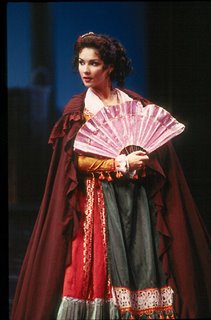 So who am I to complain that Anna Netrebko's voice is not now the glowing silver peal of 1998 (the year depicted at right), nor even the (darker) burnished steel of 2002? Someone who heard and liked those incarnations, I guess. Today the sound is remarkably large for her type, still clear, and easily produced, but no longer has the immediate sensual allure of years past. In fact she's starting to sound like another east-Euro beauty -- Angela Gheorghiu (a younger one, anyway, with an easier top) -- which makes some sense since their roles are beginning to converge. Perhaps their stardom already has.
By contrast Rolando Villazón's basic sound may be his strongest asset: the quick vibrato makes much more sound urgent, heartfelt. But his slim good looks and youthful bounding and phrasing help, and it's topped off by remarkable and effortless-seeming resources of breath. The voice is really expansive in the middle, but ordinary on top -- sort of a mini-dramatic's instrument.
The last act of Saturday's season-first Met Rigoletto showcased both the ups and downs of Villazón's sonic endowment. "La donna è mobile" made little impression, brought down by dull high notes and an uncharacteristic bout of chronic flatting. But the quartet, with Villazón spinning easy, ardent, never-ending phrases -- that was something.
His Duke is a youth, not a man: confident but quick-moving, impulsive, jumping from one thing to another (and, unfortunately, chopping phrases in the process), his fatal callousness more adolescent self-regard than narcissism or sociopathy. Phrase-chopping aside, I suppose it's a reasonable take. Surely it's not much Villazón's fault that I found myself craving another tenor's stage persona in the part...
The title part was sung well -- if neither overpoweringly nor with much mad frenzy -- by Carlo Guelfi. But the real protagonist of the night was conductor Asher Fisch. He (almost as well as Robert Heger in my favorite Rigoletto recording) liberates all the forward rhythms of the opera, midwifing an exhilarating Verdian performance that certainly won't happen under the worst conductor in Met history. Eric Halfvarson is strong, while Nancy Fabiola Herrera, though irritatingly behind the beat for the night's quartet, has a nice rounded sound. With Fisch's guidance and no weak links in the cast, Rigoletto is a success... even if not ideal.
UPDATE (11:55 AM): Alex's review at Wellsung reminds me of one thing I omitted -- the excellent work of the chorus. They, James Courtney as Monterone, and the other bit-player courtiers made the opening scene really riveting. The Met Orchestra's excellence should go without saying.
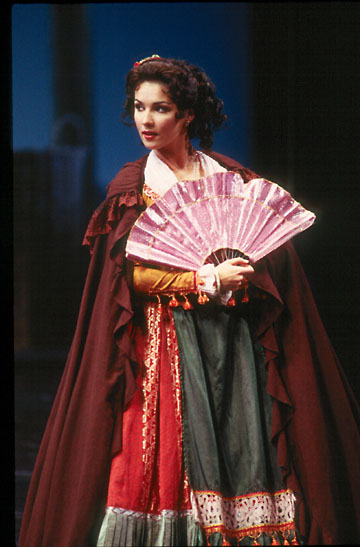 So who am I to complain that Anna Netrebko's voice is not now the glowing silver peal of 1998 (the year depicted at right), nor even the (darker) burnished steel of 2002? Someone who heard and liked those incarnations, I guess. Today the sound is remarkably large for her type, still clear, and easily produced, but no longer has the immediate sensual allure of years past. In fact she's starting to sound like another east-Euro beauty -- Angela Gheorghiu (a younger one, anyway, with an easier top) -- which makes some sense since their roles are beginning to converge. Perhaps their stardom already has.
By contrast Rolando Villazón's basic sound may be his strongest asset: the quick vibrato makes much more sound urgent, heartfelt. But his slim good looks and youthful bounding and phrasing help, and it's topped off by remarkable and effortless-seeming resources of breath. The voice is really expansive in the middle, but ordinary on top -- sort of a mini-dramatic's instrument.
The last act of Saturday's season-first Met Rigoletto showcased both the ups and downs of Villazón's sonic endowment. "La donna è mobile" made little impression, brought down by dull high notes and an uncharacteristic bout of chronic flatting. But the quartet, with Villazón spinning easy, ardent, never-ending phrases -- that was something.
His Duke is a youth, not a man: confident but quick-moving, impulsive, jumping from one thing to another (and, unfortunately, chopping phrases in the process), his fatal callousness more adolescent self-regard than narcissism or sociopathy. Phrase-chopping aside, I suppose it's a reasonable take. Surely it's not much Villazón's fault that I found myself craving another tenor's stage persona in the part...
The title part was sung well -- if neither overpoweringly nor with much mad frenzy -- by Carlo Guelfi. But the real protagonist of the night was conductor Asher Fisch. He (almost as well as Robert Heger in my favorite Rigoletto recording) liberates all the forward rhythms of the opera, midwifing an exhilarating Verdian performance that certainly won't happen under the worst conductor in Met history. Eric Halfvarson is strong, while Nancy Fabiola Herrera, though irritatingly behind the beat for the night's quartet, has a nice rounded sound. With Fisch's guidance and no weak links in the cast, Rigoletto is a success... even if not ideal.
UPDATE (11:55 AM): Alex's review at Wellsung reminds me of one thing I omitted -- the excellent work of the chorus. They, James Courtney as Monterone, and the other bit-player courtiers made the opening scene really riveting. The Met Orchestra's excellence should go without saying.
Saturday, December 10, 2005
Attention
Though I began this blog by calling opera exemplary, few people actually wish to live -- or, perhaps more to the point, die -- like their favorite operatic hero(ine). Even among singers. Though it's a change from norms set back when life expectancy was around 30, the training and hiring system today more than ever tries to protect singers, bringing them along slowly into (ideally) a long career -- one which might start at an age by which a performer of yore could already have blown out his voice.
(Some have wondered if this has inhibited the tragic vein in modern well-trained singers. That seems to me to confuse cause and effect: we live longer, and take steps based on living longer, because we have -- collectively -- largely adopted a less tragic approach to life. Besides making us rich and healthy, this choice has colored other things, moving the norm from which an individual -- performer or no -- is likely to start.)
But no system can -- or would wish to -- hide the fact that the stage is an essentially dangerous, precarious place. Like a prophet or tyrant of old, the performer is the focus of mass attention, and is in turn subject to its often-resentful whims. (One remembers how many of those prophets and tyrants ended.) This is the raw dramatic energy of opera performance: tragedy channels it into awful terrors for the characters, comedy into laughter at their folly. So each night these fictional constructs pay for their performers' prominence, freeing us in the audience to marvel at the athletic, mimetic, and other skills well-displayed. But if something goes wrong... And even when it doesn't, surely some must wonder if the substitution's something that can be carried off indefinitely, or if the real person will eventually have to pay...
Some performers live tragic lives, others are clowns (amusing or detestable), and very many live straightforwardly while off the job. Most, I think, prefer the latter -- as would most of us. (Others take part in celebrity, that satyr play-cum-romance that's the essence of popular culture, but that's tricky -- and not an aspect that shows much while in the high-cultural repertory of staged opera. For TV and concerts and miscellaneous appearances, yes.)
* * *
Blogging, too, is perilous -- hardly as much, but in much the same way, though many further deflect attention with a pseudonym. And while most don't necessarily read blogs for the dramatic one-before-many aspect, it is there, even sans applause, booing, or even fan/hate mail.
If one has even blogged himself towards death (though he's still around at the moment), that shows an outer limit to dedication -- and its possible cost. It, too, lets in that damned demanding, troublesome thing: the public eye.
So when a favorite blogger -- only thinly pseudonymous and, at the same time, a nearly-famous soprano -- goes on hiatus feeling "overexposed", shouldn't all bloggers sympathize? Even if their attention fed the performer-side aspect of the condition in the first place, and even if writing about it may feed it all even more.
(Another soprano offers her thoughts on blogging here.)
(Some have wondered if this has inhibited the tragic vein in modern well-trained singers. That seems to me to confuse cause and effect: we live longer, and take steps based on living longer, because we have -- collectively -- largely adopted a less tragic approach to life. Besides making us rich and healthy, this choice has colored other things, moving the norm from which an individual -- performer or no -- is likely to start.)
But no system can -- or would wish to -- hide the fact that the stage is an essentially dangerous, precarious place. Like a prophet or tyrant of old, the performer is the focus of mass attention, and is in turn subject to its often-resentful whims. (One remembers how many of those prophets and tyrants ended.) This is the raw dramatic energy of opera performance: tragedy channels it into awful terrors for the characters, comedy into laughter at their folly. So each night these fictional constructs pay for their performers' prominence, freeing us in the audience to marvel at the athletic, mimetic, and other skills well-displayed. But if something goes wrong... And even when it doesn't, surely some must wonder if the substitution's something that can be carried off indefinitely, or if the real person will eventually have to pay...
Some performers live tragic lives, others are clowns (amusing or detestable), and very many live straightforwardly while off the job. Most, I think, prefer the latter -- as would most of us. (Others take part in celebrity, that satyr play-cum-romance that's the essence of popular culture, but that's tricky -- and not an aspect that shows much while in the high-cultural repertory of staged opera. For TV and concerts and miscellaneous appearances, yes.)
Blogging, too, is perilous -- hardly as much, but in much the same way, though many further deflect attention with a pseudonym. And while most don't necessarily read blogs for the dramatic one-before-many aspect, it is there, even sans applause, booing, or even fan/hate mail.
If one has even blogged himself towards death (though he's still around at the moment), that shows an outer limit to dedication -- and its possible cost. It, too, lets in that damned demanding, troublesome thing: the public eye.
So when a favorite blogger -- only thinly pseudonymous and, at the same time, a nearly-famous soprano -- goes on hiatus feeling "overexposed", shouldn't all bloggers sympathize? Even if their attention fed the performer-side aspect of the condition in the first place, and even if writing about it may feed it all even more.
(Another soprano offers her thoughts on blogging here.)
Wednesday, December 07, 2005
A composer responds (in advance)
I'd read this 2001 interview with Tobias Picker before the production, but it's more funny now:
In the '60s and '70s when American modernism was at its height, when 12-tone composers were chic, the critics bashed the shit out of them because they were writing music that was inaccessible. There was a constant stream of vicious criticism and harassment, led by Harold Schonberg and the critics of The New York Times, directed toward my teachers, Elliott Carter, Milton Babbitt and Charles Wourinen, who were leaders of the American modernist movement. This has now turned full circle. As soon as composers started writing music that was accessible, the critics starting bashing the shit out of us. It proves that some critics will find no good in anything, and this basically renders most music criticism meaningless.UPDATE (5:30 AM): Composer-blogger Daniel Felsenfeld asks a related (if more restrained) question.
The very busy...
I hadn't realized that An American Tragedy's younger Clyde, Graham Phillips, was also the lead for half of NYCO's run of The Little Prince (closed 11/20). Not a bad few months' work for a sixth-grader.
The current show uses his actual voice. I'm sure it's a stretch to expect a child to sing for the hours' length of Little Prince -- even on and off -- but NYCO's solution of massive (by opera-house standards), jarringly different-sounding amplification really made a mess of that production. Surely it wasn't quite so bad in Houston? (The unwise innovation of this time casting the Rose as a teenage soprano meant they did much the same for her.) But I suspect I'm the only one grinch enough to so complain, though Peter Davis does trash most everything else.
Meanwhile, if any readers went to this American Tragedy event yesterday, I'm curious to learn what was said.
The current show uses his actual voice. I'm sure it's a stretch to expect a child to sing for the hours' length of Little Prince -- even on and off -- but NYCO's solution of massive (by opera-house standards), jarringly different-sounding amplification really made a mess of that production. Surely it wasn't quite so bad in Houston? (The unwise innovation of this time casting the Rose as a teenage soprano meant they did much the same for her.) But I suspect I'm the only one grinch enough to so complain, though Peter Davis does trash most everything else.
Meanwhile, if any readers went to this American Tragedy event yesterday, I'm curious to learn what was said.
Tuesday, December 06, 2005
Press roundup
I think Alex of the Wellsungs is entirely right to dissect Tommasini's reflexive and cliched dismissal of An American Tragedy. One further point I'd add: 1950 is just as much unrecoverable past today as is 1905 or 1850. A rearguard defense of modernism won't turn back the clock from its aesthetic successors.
Oh, but who has the space to do justice to the riotous melange of honest opinion, grinding axes, insight, generalization, quick conclusions, and bizarre hobbyhorses that makes up the rest of the press coverage? It almost takes one back to the delightful old days before hundreds of years of noisy fan appreciation forced critics to dress their hatreds in polite language.
Most amusing, I think, is the pair of Jay Nordlinger and Willa Conrad, who each attribute the rather more lugubrious political agenda of Dreiser's book to the opera, to opposite ends: Nordlinger deplores it, which seems to dim his view of the rest of the proceedings, while Conrad pretty much finds it the only element of the evening worth keeping.
Of the others, only the AP's Mike Silverman gives a mixed evaluation. The remainder trash it, with more or less style. Of these, I think Matthew Erikson of the Hartford Courant is the most interesting and grandees Martin Bernheimer and Clive Barnes the least. Mark Swed of the LA Times (who, incomprehensibly, liked the Harbison fiasco!) offers another ideological attack, while Newsday's Justin Davidson and Variety's Eric Myers just found the show dull. (Oddly, the latter give no report of the -- contrary -- audience reaction.)
Your milage, needless to say, may vary. This is definitely an instance where one should see for oneself.
UPDATE (12:20 PM): OK, maybe the Wellsungs are up to fisking the whole lot of 'em. Jonathan's funny take on Eric Myers here.
UPDATE 2 (12/7, 3:30 AM): More ink -- Chicago's John von Rhein, though quite fair-minded on the whole, wishes LOC's composer William Bolcom had written it (having seen A View from the Bridge, I don't), while Charles Ward of the Houston Chronicle does his own press roundup.
UPDATE 3 (12/8): A positive review from the Philadelphia Inquirer's David Patrick Stearns.
Oh, but who has the space to do justice to the riotous melange of honest opinion, grinding axes, insight, generalization, quick conclusions, and bizarre hobbyhorses that makes up the rest of the press coverage? It almost takes one back to the delightful old days before hundreds of years of noisy fan appreciation forced critics to dress their hatreds in polite language.
Most amusing, I think, is the pair of Jay Nordlinger and Willa Conrad, who each attribute the rather more lugubrious political agenda of Dreiser's book to the opera, to opposite ends: Nordlinger deplores it, which seems to dim his view of the rest of the proceedings, while Conrad pretty much finds it the only element of the evening worth keeping.
Of the others, only the AP's Mike Silverman gives a mixed evaluation. The remainder trash it, with more or less style. Of these, I think Matthew Erikson of the Hartford Courant is the most interesting and grandees Martin Bernheimer and Clive Barnes the least. Mark Swed of the LA Times (who, incomprehensibly, liked the Harbison fiasco!) offers another ideological attack, while Newsday's Justin Davidson and Variety's Eric Myers just found the show dull. (Oddly, the latter give no report of the -- contrary -- audience reaction.)
Your milage, needless to say, may vary. This is definitely an instance where one should see for oneself.
UPDATE (12:20 PM): OK, maybe the Wellsungs are up to fisking the whole lot of 'em. Jonathan's funny take on Eric Myers here.
UPDATE 2 (12/7, 3:30 AM): More ink -- Chicago's John von Rhein, though quite fair-minded on the whole, wishes LOC's composer William Bolcom had written it (having seen A View from the Bridge, I don't), while Charles Ward of the Houston Chronicle does his own press roundup.
UPDATE 3 (12/8): A positive review from the Philadelphia Inquirer's David Patrick Stearns.
Subscribe to:
Posts (Atom)