Monday, September 11, 2006

Five years in the new world

Three hundred and sixty-four days a year draw us "on topic", to our niches of work, friends, home, and habit -- the lives we build for ourselves in this elaborate, largely predictable framework that's civilization. But today one can't avoid the abyss over which we've lived for years, which materialized wholly and unmistakably five years ago.

That day's Islamic terrorists rehearsed the gruesome small details to enact the gruesome large ones, in deliberate acts that were no "tragedy" (nor, of course, "art") but mass murder -- crimes, acts of war, abomination -- and a sick fantasy enactment of "martyrdom".

Many cheered -- quite literally -- both abroad and, yes, even in New York.

*     *     *

Those who would enact more such horrors, those who would fund them, and those who would cheer: all still plague us. The next shoe that drops may be worse, much worse. We are neither collectively helpless nor, I think, doomed, but I suspect the natural reflex to avoid looking down at what horrors could be has dulled our true sense of things. And the more likely such horror looks, the stronger that reflex.

Today, however, our mortal danger gets its due. (Except by the deranged.) How it might (again) look. How it might (again) feel. The rupture of every thing and certainty, that may (again) happen. Lest we forget...

It will be a long road before we can afford to, even for a while.


UPDATE: The last embedded video I had put up seems to be overloaded, so I've unembedded it for now. It can be found here when the server recovers.

Tuesday, September 05, 2006

The slow reunion

While greats of old continue passing, the New York season begins its beginning this week with some festive City Opera preliminaries. Some point soon, the metacommunity of the city's music audience will have reconstituted itself from near and far, as if it had never been dissolved. But it was -- any summer event here may as well have been in a different city altogether.

As for myself, I've not had a happy or productive summer for as long as I can remember. This one was no exception: good riddance!

But I welcome you all as you file in for the third season of An Unamplified Voice, scheduled to kick off very soon.

Monday, August 14, 2006

Old defaced torso

Perhaps it was the venue. I'm not sure what sorts of events the Time Warner Center's ugly and hard-to-access Rose Theater usually hosts, but the last "operatic" event there turned out to be a disappointing pop cultural melange.

Then again, I now recall that it was Peter Sellars who directed the Golijov piece, as well as the presentation of Mozart's (unfinished) Zaïde seen last Friday. But he and Golijov are a natural couple. Mozart, not so much.

The most obvious thing about the Zaide fragment is that it's, well, fragmentary. The piece lacks an ending, but more jarring in performance is the absence of any dialog linking the numbers of this singspiel. Sellars adds no dialog -- skeletal, updated, or otherwise, though he does interpolate a few numbers from another Mozart fragment (Thanos, King of Egypt). Instead he has the performers crudely pantomime in the grossest stereotypes: Gomatz as prison bitch, Osmin as a fried-chicken-eating hood, Allazim as the magic negro, and Zaide herself as a submissive-then-shrill Chinatown FOB (her actual costume being rather more loaded than that shown in the PlaybillArts link above). These latter depictions crossed, I think, the line into racism, but perhaps more offensive was how insultingly stupid they all were in light of Mozart's musical characterizations. Only Soliman was allowed some variety of poses -- none subtle.

These were intentional choices, and show Sellars and Mozart working at cross purposes. Sellars, as with the Golijov piece, tries to heighten the populist sense of the piece by flattening out individual aspects of the characters, leaving them more symbols of oppression and victimization. So Gomatz, with nothing to say, has no personality and is merely (and purely) pathetic; while Zaide herself -- whose music threatens to open spaces of expressive and human variety -- is otherwise straitjacketed in strict stereotype.

Now it's true that Mozart's form for Zaide -- a vernacular rescue opera employing not comedy but (at times) melodrama -- invites a certain amount of popularizing and cartoon-izing. (One sees it even in Fidelio, in the mustache-twirling aspect of Pizarro that's difficult to take seriously.) But nothing in Mozart is as inhumanly didactic as Sellars would make this piece; the personal and individual foibles of the suffering always get space. (And perhaps he abandoned Zaide for its inflexibility on this point. The comic angle of the later Entführung provides more possibilities.)

*     *     *

I regret, in part, compounding the Mostly Mozart Festival's error in headlining Sellars' contribution to the show. That he made himself the story with a harmful staging was part of the evening, but could hardly be the whole in a Mozart evening. But the musical haul was itself mixed. Festival music director Louis Langrée led the period group Concerto Köln in a viscerally exciting account of both Zaide and the Thanos excerpts. This seemed to play to their strengths as an ensemble, while being of a piece with the popularizing tone of the production. But excitement worked against tenor Russell Thomas (the Soliman -- whom, incidentally, the Sun's Fred Kirshnit misidentified as a bass-baritone): usually precise as well as fascinatingly intense, he'd apparently been encouraged to sacrifice much of the former for a bit more of the latter. Still, I hope to hear him in more leads soon. The best singer on the night was bass-baritone Alfred Walker (as Allazim), whose rich dark tone was the event's main pleasure. The others, unfortunately, made little vocal impression.

Is Zaide an overlooked masterpiece? It's hard to say. The piece is best known for Zaide's arias, but Korean/American soprano Hyunah Yu (the only non-black singer in the cast, by bizarre intention) didn't -- or wasn't allowed to -- make much of them. As for the rest, the lack of dialog threw off the pacing of the work as a whole, which actually seemed much longer than it would have with some intervening talk. And I admit being unable to ignore a particularly bad or offensive staging. So -- ask me again, after a better-realized concert version.

*     *     *

The veneer of contemporary commentary is too silly and tiresome to discuss. But it -- as laid out at length in synopsis and program notes -- shows that Sellars would've had no problem adding dialog, if he'd so chosen.

Friday, August 04, 2006

A era or two ago

Does the death of Elisabeth Schwarzkopf have, as Maury suggests, some of the passing of an era in it? Not, surely, that sonic era of postwar Vienna (which, if it survives as a person, has been near Bern for ages). Schwarzkopf's virtues were not theirs.

Perhaps her phenomenon (as opposed to her work itself, which one could hear and see and is more or less representatively preserved for current judgment) is most interesting as a sort of high-tide for the critic, particularly the London variety. Presence and looks she had, for sure, but these alone did not make hers a name to which one could safely attach any praise or expect non-musical people to recognize, nor let, e.g., her hilariously misjudged Schubert disc be taken seriously.

But that's probably a step more than is necessary: was she not simply the first ubiquitous singer of the LP era, as Pavarotti and Domingo have been in CD times? Ah, the days when people believed in studio recordings!

She was neither the last, nor the greatest, but she was for a while the most praised. That is something.

Friday, July 21, 2006

As promised

As video appendix to previous commentary on the Volpe Gala, its defining moment:


Natalie Dessay (and Elaine Douvas, et al.) in Bellini's Sonnambula finale. The set -- of which she actually makes brilliant use -- is from Act I of Zeffirelli's Traviata production.

A blogger in performance

Lower Manhattan's River to River Festival will present baritone and blogger Tom Meglioranza in a free recital this coming Monday at Pace. Having heard him last summer at the Naumburg finals, I think this event should be interesting -- worth attending.

Wednesday, July 19, 2006

In case you were wondering...

I make no claims to being any sort of "superlistener".

(But I am -- to go off-topic -- a longtime Matt Kramer fan.)

Thursday, July 13, 2006

The show must go on

A week after Lorraine Hunt Lieberson's shocking-if-unsurprising passing, online talk has already bubbled up about her possible replacement in next season's Met/Mark Morris Orfeo. With Hunt, it was the most anticipated event of the coming season. Now -- as it's probably impractical and definitely unwise to cancel the production -- things are up in the air. There's no official word (or strong rumor) on a substitute, just speculation.

From a purely vocal standpoint, I wonder if the house could do better than one of its own youngsters. I'd never thought I'd hear a sound like Kathleen Ferrier's, but Tamara Mumford's lower register has some of that great Orfeo's uncanny contralto timbre. Even more remarkable, I think -- and again recalling Ferrier -- is the pure, unforced seriousness of the young mezzo's natural manner. It's too bad opera has few leading parts for such a combination.

But I suspect it's unlikely that the Met would entrust a new, high-profile production to a twentysomething-year-old third-year Lindemann singer, no matter how talented. So if it's to be a "name" star, I'd like to see Vesselina Kasarova -- an excellent singer who hasn't yet been shown in her element in New York.

Naturally, I'm sure Peter Gelb et al. have their own ideas.


UPDATE (7/19): Via a helpful commenter, the replacement seems to be David Daniels. Those who've read the archives may recall that I consider the countertenor-in-old-repertoire phenomenon essentially fraudulent, and Daniels -- whose voice sits far too high for these parts -- doubly so. I've no doubt this choice will sell tickets, but what an artistic waste.

Wednesday, July 12, 2006

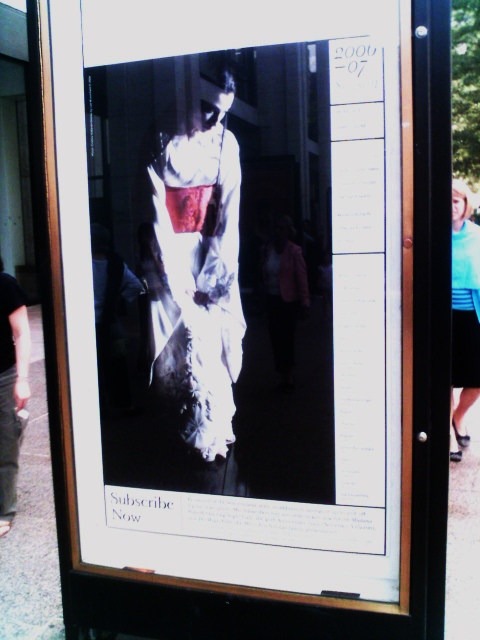
It at least makes a striking poster

The new Met season ad, which shares a font and other design elements with the graphics-overhauled Met website.

Friday, July 07, 2006

More Levine

A friend points me to this conversation with James Levine on today's Soundcheck show. Levine's finally back in action tonight, at Tanglewood.

Opera talk starts at around 8:40 of the clip.

Wednesday, July 05, 2006

A long-unexpected passing

I return from holiday business to find Lorraine Hunt Lieberson dead. Others probably heard and loved her more. I actually found her opera work not-quite-up-to-hype until I saw that first shockingly perfect Didon. The evening of that premiere was a triumph of the first magnitude, and I'm glad she saw one like that on our biggest stage.

Friday, June 30, 2006

Thursday, June 08, 2006

A reader writes

(Blogger is really acting up: I've been trying to post this all day.)

One of my readers provided, via email, this response to my question on televising the Cav excerpt:
I think the reason they had the Cavalleria part in the Gala, and left in for the telecast, was that was the one opera Volpe knew as a child, having to sit there and turn over his grandmother's 78 records. It's been told to be the only opera recording she had, and he was the only one who had that "job."

So, makes sense, right? Part of the Volpe legend.
Yes, that makes perfect sense. Thanks!

Friday, June 02, 2006

TV notes

(Previous posts on the Volpe Gala here and here. Maury offered his top-to-bottom detailed account here and here.)

Somehow the intervention of TV broadcast has here a levelling effect, to some extent lumping decent and great, huge and muted, together into indifferentiable mush. Is it the medium? Editors' intervention and equalization? Or just my inability to concentrate on a repeatable broadcast of something I've already seen... Perhaps one who wasn't there can make more of this version.

On the other hand, the broadcast reveals quite well, e.g., the really unhappy caution of Ben Heppner's Prize Song (why did they leave this in?), and how much of Kiri te Kanawa's voice is and isn't left (a surprising amount of the former -- Thomas Allen bluffed his way through this season's full Cosi run with less).

Editors' snips left (in order) Dwayne Croft, Denyce Graves, Stephanie Blythe, Sam Ramey, Roberto Alagna, and Dolora Zajick entirely on the cutting-room floor, while significantly chopped were the Met Chorus (the Tannhäuser selection reduced to intro title music), Deborah Voigt and Placido Domingo (one piece each), and Susan Graham, whose cutesy Ben Moore song had its entire middle section cut out. (Were there other in-aria snips? I didn't think to listen for them until very late.) Salvatore Licitra arranged his travel plans poorly, while Ruth Ann Swenson had to drop out of the afternoon's matinee (and ABT's opening night the next Monday) due to allergy: both, accordingly, were scratched before the original evening's start.

*     *     *

Assorted thoughts:

Domingo might be the ideal gala singer. He retains a surprising quotient of vocal glamour and -- for five or ten minutes of an evening -- can deliver it easily, ultra-professionally, on command. What a respecter of the gala form! One who wouldn't think of disrupting it with something less reassuring than high-wattage star power -- e.g., serious dramatic commitment. But that sounds snarkier than I intend.

Actually Domingo's way seemed ideal for the evening until Natalie Dessay soon after raised the stakes considerably. And not just by her performance (for which I'll try to figure out youtube, if another hasn't already uploaded the thing): all applause was neatly trimmed for telecast, but her ovation was thunderous, and so persistent that she had to be brought back for another bow. A challenge, then, for those after.

Kiri's solo bit -- Korngold's "Glück, das mir verblieb," arranged so she sings both parts -- was, appropriately enough, one of the few valedictory selections of the event. Much more of a farewell for her, I felt, than the relatively anticlimactic Capriccio that saw her out in '98. (I was present for that too, incidentally -- it was the very broadcast that Maury remembers.)

Hvorostovsky and Pape in Don Carlo(s): Coming soon, again. Get your tickets now.

Probably the most bizarre editing choice was cutting Dolora Zajick's remarkable (yes, she can lighten her voice!) "O mon Fernand" and leaving in, e.g., the interminable Cav bit. Is the latter piece generally beloved with an intensity of which I'm unaware? Or is there some sort of odd anti-mezzo bias that also axed Blythe? Odd.

Only Karita Mattila could make a sentimental operetta song actually about erotic catastrophe. But her byplay with Hampson was charged in a charming way.

Domingo's fraudulent stick-waving got rather more airtime than the real conductors'. Hah. But when Levine's away...

*     *     *

What was it all about, then? A bunch of things, Volpe only one. Maybe too many, or too few. But it did add up to something. Viewing it left the same basic impression I got on the day: How fortunate we are. How fortunate he was. Why carp?