Tuesday, May 30, 2006

Summer season, New York edition

Although this next month is, as far as I can tell, an operatic desert, July brings some opportunities in and around the city.

Despite troubles in LA, film composer Elliot Goldenthal's new opera "Grendel" should begin its New York run July 11. It doesn't look all that promising, but who knows?

August in the city is better, with Zaide and Idomeneo at Mostly Mozart, and the Met's Rigoletto and Traviata in the parks.

Outside city limits:

Caramoor (Katonah, NY)
July 8 -- Puritani with Sumi Jo
July 22 -- Tancredi with Ewa Podles
New Jersey Opera Theater (Princeton, NJ -- the newer ~380 seat stage)
July 7, 9 (mat), 13, 22 -- Cosi
July 8, 14, 16 (mat), 20 -- Elisir
July 15, 21, 23 (mat) -- double bill of "Gianni Schicchi" and Michael Ching's "Buoso's Ghost"
Princeton Festival (Lawrenceville, NJ -- at the Lawrenceville School)
June 24; July 1, 9 (mat) -- Butterfly
July 1 (mat) -- The Old Maid and the Thief
There are, of course, plenty of events further afield, but these are in the range of a simple day trip.

Tuesday, May 23, 2006

Volpe: The Event

Some bloggers have been prodding me to write more about the Volpe Gala. A few words, for now.

*     *     *

The problem with galas is that they higgledy-piggledy touch too many parts of the opera experience. Pleasure comes from the past, the present, sound, drama, and not least the social occasion. But few enjoy all of these in equal proportion; if there's something for everyone in a gala, there's usually also something to dislike for everyone. It's part of the dizziness: under what lens is each particular bit supposed to make sense? In what context?

At any rate, I don't think a "who missed and who scored" roundup is the most fruitful approach (though I find Maury's valiant effort interesting), and in fact misses the point as much as not. Best, maybe, to start from what was preserved (next week's telecast) and go from there. (One thing that may not be evident on TV, incidentally, is that Frederica von Stade's solo number was noticably if semi-discreetly miked.) I plan a post on that, as well as some thoughts on the Volpe era.

*     *     *

Still, one bit of perspective. Though he was running much behind-the-scenes activity before, Volpe officially took over in 1990. Karita Mattila had made her Met debut that spring, as Donna Elvira. Just two years before -- in 1988 -- Renee Fleming, Susan Graham, and Ben Heppner had won the Met Council auditions, and Deborah Voigt (a Met Council winner in 1985) had gained prominence from winning Pavarotti's competition in Philadelphia. So that was the beginning, and the backbone of both the current roster and the gala itself.

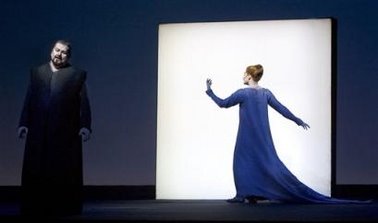
1998, then, was the midpoint of Volpe's tenure. In the spring, Kiri te Kanawa appeared in her last staged production here: the house premiere of Capriccio. Voigt and Heppner opened the controversial (and lately triumphant) Robert Wilson Lohengrin. In the fall, the eternal Placido Domingo and Olga Borodina -- who had just debuted the previous year! -- opened the season in Samson et Dalila. Mattila took her first turn as Elsa (after having done Musetta just two years before). And Fleming starred -- with not-quite-Met-regulars Cecilia Bartoli and Bryn Terfel -- in the then-new production of Figaro that's with us today.

And in 2006...

Monday, May 22, 2006

The odd couple

More revealing, I think, than the almost embarrassingly successful second half of the previous Saturday's Dorothea Röschmann/Ian Bostridge duo recital was its first.

They began the all-Schumann program with his Op. 78 duets. Rapport was bizarrely lacking: the two seemed psychically separate, perhaps even at odds. The lightly cruel comic interplay of Tanzlied worked fairly well; the other songs not so much.

The solo selections of the main course -- the complete Myrthen, Op. 25, divided between the two -- shed a clearer light. Bostridge, despite his stage contortions, inability to look at the audience, etc. (all fully evident this evening) -- or perhaps enabling these -- he is certain of his audience, and comfortable within them. Whether by stardom or birth, he acts as if their response is guaranteed, and shapes effects for them with confidence.

Röschmann, though, is naked, almost terrifyingly so. She began as one tentative, singing Der Nußbaum (one of the cycle's famous selections) with little blissful dreaminess but much of the therein-mentioned girl's young longing. Desire is her metier -- a lover's desire, exquisitely vulnerable to nonreciprocation; delivered on her quick and expressive vibrato, it's an operatic wonder. But how strange it was to see this great artist apparently taking such a position vis-a-vis this recital audience... Her body language genuinely seemed to doubt its approval or even acceptance. (Did she think it all simply Bostridge fans?)

Not until her songs' emotions reached heights of woe, rapture, and faith -- in unforgettable, totally immediate performances of Die Hochländer Witwe and Rückert's two "Lied[er] der Braut" -- did Röschmann appear sure in who she was, and bring a balance to that recital stage.

Julius Drake accompanied the contrasting pair with unending sympathy and natural-as-breath phrasing.


UPDATE (5/23): I hadn't realized until today that Röschmann and Bostridge's program duplicated this disc they did in 2002 for Hyperion's Schumann song series. If it weren't for my wierd inability to listen to recordings these last few years, I'd offer a comparison. I'd be interested in the thoughts of any who've heard it, though.

Sunday, May 21, 2006

Saturday, May 20, 2006

Past and future

This article from Monday's New York Sun demonstrates Peter Gelb's remarkable talent for getting reporters to take his spin of renewal and novelty at face value. It's valuable -- he needn't actually tamper with success to generate hype. (Whether he nevertheless will tamper remains to be seen, of course.)

*     *     *

Tonight I -- along with pretty much everyone else in operaland -- will be in attendance at Joseph Volpe's retirement gala. I may try posting by email at the break, though giant gala gatherings don't usually inspire such brevity. Those not able to attend can listen (with a slight delay) on internet radio. Either way, it's a fittingly grand conclusion to the season.

Friday, May 19, 2006

Mr. Radvanovsky speaks...

Unwittingly, to a blogger.

Incidentally, most reviews of those London Cyranos are unhelpfully Domingo-centric.

Wednesday, May 17, 2006

Once upon a time

Among the stories of yesterday's abominable anniversary was this tidbit:
Take the case of Hao Jiangtian. He is one of the New York Metropolitan Opera's superstars. But he grew up in China during the Cultural Revolution when classical music was considered capitalist and decadent.

His piano teacher was thrown into prison. His musician parents destroyed all their classical records to avoid the same fate, and many of their colleagues committed suicide.

But now it is not the past he wants to talk about but the future. He says that since the Cultural Revolution, millions have started to study music in China and he is playing a key role in helping them develop their talents.
Hao will, incidentally, be in the cast of the Met's new opera next season. Will it (like its director's recent movie), I wonder, apologize for the murderous, arbitrary, rapacious and tyrannical strain that has yet to pass from Chinese government? I was concerned enough before I learned (from a myth-perpetuating Times article) of the Ford Foundation's involvement...

Sunday, May 07, 2006

More

Press neglect of the most stunning Met debut in decades (sic!) continues, so a few more of my words on Wednesday's Lohengrin.

Besides Karita Mattila, it was a wholly different cast from opening night's. Klaus Florian Vogt aside, this second cast (Margaret Jane Wray, Greer Grimsley, Rene Pape, and Charles Taylor) brought stronger, beefier sounds than their predecessors. But not only sound changed, but apparent relationships between the characters. The villains first. Grimsley's Telramund was a stern, unyielding one, lacking the melancholia of his predecessor. His wife (Wray), on the other hand, became more human, perhaps too much so. The warm vibrato-bearing middle of her voice was welcome to hear (the wild top, on this night, less so), but combined with a more relaxed and straightforward manner of posing to make Ortrud seem oddly non-villanous; the fake fawning over Elsa appeared somehow more in character than her pagan curse.

Between Vogt and Mattila it was quite different. Mattila had not, as I feared, imploded under the outrageous strains of this production (coming after some taxing Fidelios), but she wasn't finding the singing as easy at the end of the run as the beginning. (She sounded outrageously strong this night.) Nevertheless (or therefore?) she was as dramatically present as ever.

With Vogt, their characters' dynamic snapped cleanly into focus. Of otherworldly delicacy in sound, his Lohengrin was similarly pure in manner: masculine still, and instinctively righteous when challenged, but free from the torment, envy, and uncertainty of true mortals. Alas, Elsa is all too human; despite having dreamed of divinely touched being (having an affinity for it), and desperately desiring him as the missing element of her life, she cannot really believe that he can exist, not in the same world as the endlessly base Ortrud and Telramund. It's their examples that ensnare her more than their arguments.

*     *     *

Yesterday Vogt seemed to save much of his best sound for the third act, which was remarkable indeed. (That messa di voce on "taube": exquisite.) Mechanical problems -- which got Wednesday's performance off wrong too, as King Henry's mobile platform rolled awry and ran into a light prop -- didn't help the start; not only were many Met Titles screens down for Act I, but Lohengrin's swan didn't make it in from offstage for his entrance. I think most of the audience figured Wilson just wanted it swanless: what they made of Act III's avian debut I don't know. But by the latter acts it was forgotten for a memorable performance, perhaps the best yet at delineating character (Richard Paul Fink and Luana DeVol outdid themselves on that front this evening).

*     *     *

Blog commentary on Wednesday's debut at Operacast, Balcony Box, and two blogs new to me (and the latter actually new to the world). Meanwhile Maury offers thoughts on Saturday's second Vogt performance (and some very funny pictures).

UPDATE (4/9): Alex at Wellsung also weighs in on the Saturday performance, while Geoff Riggs at the Operacast blog is inspired to an insightful essay.

Meanwhile the only press notice is this headscratcher from Martin Bernheimer, who seems to see only what he expects to see.

Thursday, May 04, 2006

Meanwhile, in structural news

Despite a very optimistic article in last week's NYT (which now looks rather odd -- all quotes being from one side), New York City Opera's plan to move across Amsterdam Avenue (the back side of Lincoln Center) is apparently toast.

On the one hand, it would be nice to have a somewhat smaller, built-for-opera hall in the city. (Though who knows if they wouldn't still continue to use sound sweetener.) On the other hand, it's hard to see how going from 2750 to 1800 seats would have meant anything but price increases all around...

Not since...

If Ian Bostridge were a heldentenor, he would be Klaus Florian Vogt. No -- not exactly. If a tenor had all the youthful vulnerability, pinpoint delicacy of word, phrase & dynamic, and purely lyrical (sometimes plaintive) tone of, say, Bostridge (Polenzani? McCormack? -- insert name here), but within a heroic stage persona and instrument that projects easily over a full Wagner orchestra for all of Lohengrin... If he sang it as gracefully and authoritatively as a Schumann lied...

That would be impossible, right?

Honestly, I couldn't have been more amazed if this Vogt had ridden in on an actual swan. Nor, I think, the rest of the stunned and explosively loud audience.

I don't know what Vogt will have done in five years, or ten, or twenty. But I'm glad I witnessed this night's marvel with my own ears.


UPDATE (8:45AM): I've slept a little & read some Opera-L notices, and I still can't believe what I heard last night. It's still clear in my ears, though.

Incidentally, if the post does not make clear -- this was Vogt's Met, New York, and American debut.

Thursday, April 27, 2006

Timing

After an odd weeklong silence, Opera-L was finally abuzz Tuesday with talk of the Met's Lohengrin revival. Interesting to see more opinions. It's somewhat jarring, however, to read confident conclusions as to principals' vocal essences when this third performance was -- sonically speaking -- quite noticably Heppner's most and Mattila's least in-form evening of the run. (Not that either sounded bad at any point.)

Of course the phenomenon will repeat Saturday, when the close miking and dynamic compression of broadcast will add their own distortion. Nonetheless, strong opinions will take hold.

On the other side, performers surely know that most of each evening's audience will have just that particular impression for maybe the next year or more, and without being privy to the nuances of one's physical state at the time.

I've tried to include qualifiers in blogposts that go on isolated samples, though I'm sure I've neglected this at times. And though I don't much like extreme hit-and-miss performers, I do find the general unpredictability and uncertainty of the art positively stimulating. -- This is part of what charges an audience before the event, an energy with which some can do wonders (and which unfortunately fells others).

Friday, April 21, 2006

Thursday, April 20, 2006

As promised

I've expanded my post on the Met's revival of Fidelio -- see below.

Tuesday, April 18, 2006

Volpe's last triumph


I was living elsewhere on the east coast in 1998, so when a friend told me that Karita Mattila had really made something of Elsa in the fall's Robert Wilson Lohengrin revival, I still passed. I'd been at the production's infamous premiere that March, and though I didn't hate it enough to boo with the rest of the crowd, enough of it struck me as agonizingly silly to make quick reprise doubtful. Mattila, too -- though she had turned the corner years before -- I associated with her prior incarnation, that well-schooled but unexciting soprano who'd graced the stage for the dozen years after Cardiff.

So I can't say what happened seven years ago. But last night's likely even more remarkable: Mattila and company have made that notable flop of the Volpe era into its last great success.

How much of the original remains, I don't know. (No new assistant directors or the like are listed in the program.) As I recall, Wilson intended the poses and wavy hand movements to be not merely anti-naturalistic but actually alienating. This plus the austere, static, and almost color-free set design were deadly in the hands of the premiere's mostly stand-and-sing cast, for whom in-mood sets and gestures are necessary to buttress sonic illusion.

For this cast, though -- most of all Mattila and debuting soprano Luana DeVol -- the distancing and tortuous poses are (as here revived) near-ideal frames. They isolate and resist, but do not (again, as here revived) bar nuances of physical response. In fact the resistance encourages them, dares each performer to continuously push back -- vocally and fine-gesturally -- against this formal tether. The result is the densest performance I can recall; so much happens in such a small space, at an emotional pitch heightened by the called-for control. Just to see Mattila's arms in Act 2 is more than the entirety of Schenk's Don Pasquale (or, indeed, most of his Ring...); the whole is more even than her work in other stagings where her engagement floats free, or comes linked just to climaxes. And such dense concentration caught up the whole cast (chorus included), who if not so minutely engaged were yet present with remarkable collective focus.

And so, the glacial non-movement of Wilson's physical production seemed more sensible. Even the end, criticized at the time for showing neither Ortrud nor Elsa expiring, made some sense as we saw that live stage presence of Mattila's, amplified all evening in her physical labors, simply ebb away on hearing Lohengrin's account.

This was DeVol's Met debut, despite a long career (including Bayreuth) in the big Wagner parts. Her voice, despite any technical litany (to start: is it one voice, or fragments?), has to my ears all these fascinating and (at low-mid volume) beguiling textures in it. She makes much of them, and is an interesting complement to the clear-toned but similarly volatile Mattila; I'd much like to hear them paired elsewhere. Still I'm sure she'll be controversial, particularly to those listening for a certain sort of aural beauty.

But the evening was about something quite different, and any beauty-based review is, I think, serious misrepresentation. Even Levine fill-in Philippe Auguin's somewhat dry sound mattered less than his responsiveness, and the countless gradations of feeling he caught in characteristically objective style.

For those with senses to hear and see such things: go. (Before the cast implodes from stress.) The radio, I'm afraid, will be more misrepresentation. A telecast/DVD would be fantastic -- if last night's fairly traditional bunch can be roused, anyone can -- but I'm afraid the Met lacks money and DG lacks sense (they're still sitting on the "full Mattila" Salome).


UPDATE (2:30PM): The event draws bloggers forth in praise: Steve Smith, Jonathan at Wellsung (and more), Maury, and even the long-absent Sieglinde.

Monday, April 17, 2006

Five Fidelios

As Met Mattila Month approaches Phase Two (expensive lights! wriggling hands! a spear twirling in midair!), perhaps I might recap Phase One.

Karita Mattila was supposed to sing six performances; she did four. James Levine was supposed to conduct the run; Paul Nadler did so. Cover Erika Sunnegårdh was supposed to get one performance -- the last; she did three including the broadcast, and got a huge amount of media coverage to boot.

Beyond those broad facts were the actual events. I'd long anticipated this run as a chance to see Mattila's Leonore without thinking so much about Jürgen Flimm's production: after several runs, a bit of touring, a telecast, and a DVD, its flaws and follies are by this point fait accompli, something a repeat operagoer can more or less tune out. (I did overhear others, new to Flimm's take, stumbling over it.) The orginal run started fairly well -- you can get the gist of this from the DVD, which captured early performances -- but ended with a string of incandescent dramatic successes for which I lack sufficiently purple prose. Seeing one of the latter got me going to all* of Mattila's New York performances since.

[* Subject to circumstance, of course, and the fact that no sane person should see seven Salomes in a month.]


What most stood out this opening night was Paul Nadler's extremely brisk tempo choices and his even brisker phrasing. He's perhaps the best of the Met's no-name conductors, able to get good sound from the orchestra and to keep things moving well. But this time the absence of contrasting repose -- even in the quartet and the prisoner's chorus -- made Levine's cancellation more noticable: he, as indeed Peter Schneider in the last revival, had made much of Beethoven's slower writing without hurrying it forward. Further, many involved -- singers, chorus, and even parts of the orchestra -- seemed unprepared for Nadler's desire to press ahead over and over.

Second and third performances were better: more together and with a touch less haste, showing more of the virtues of Nadler's brisk conception. It seemed everyone was finally getting on the same page. Then, of course, the lead changed.

*     *     *

Sunnegårdh was nervous from the first at that broadcast-cum-debut: everyone in the house could feel it. There was this tense sensation that something really unfortunate was likely to happen. It was almost worse: when she got very lost in her big aria and had to stop, for a moment I wondered if she wasn't going to be able to continue at all... But she did, and only made one minor flub afterwards (fumbling the words to "Ich bin es nur noch nicht gewohnt", as oddly enough Mattila had done that Tuesday). She came back much stronger for Act II, and finished well.

There's much one could say about Sunnegårdh's voice and prospects, but I think this excellent Opera-L post pretty much covers it. The instrument is still unfinished, though, so who knows? As an actress I found her very interesting. Mattila's Leonore -- or, rather, Fidelio -- is so masculine that the breakdown she has upon finishing the deed seems quite natural. Sunnegårdh is more conventional, more feminine: one can see that Marzelline likes her Fidelio for his androgynous sensitivity, more Leonardo DiCaprio than James Dean. Act II is more desperate than heroic, and there's no post-rescue histrionics. But it's all quite natural and nuanced, and so easily done for her first time onstage in the part.

The supporting cast was strong throughout this run. Most praise to Alan Held, whose audible menace showed the value of a real (if still maturing) heldenbariton as Pizarro. Rene Pape succeeded with an unconventional, brilliantly acted, almost tortured Rocco in the original run; here Kristinn Sigmundsson was a fine conventional (fatherly, dark-voiced, somewhat jovial) one. Both Florestans did well, Richard Margison impeccable after a softly taken "Gott!" and Ben Heppner even better, as heroic as he's ever sounded and an order of magnitude better than he did six years ago. Gregory Turay was near-ideal as Jaquino -- not too pretty -- but Jennifer Welch-Babidge sounded a bit under the weather herself as Marzelline (Amy Burton, in her one performance, showed a clearer but somewhat harder sound). And for once, both prisoners (Lindemann tenor Russell Thomas as the first and unknown-to-me John Shelhart as the second) impressed in both voice and soul.

*     *     *

Mattila. She sang terrifically while healthy and quite strongly even upon returning (for the fifth performance I caught) with a bit of illness left over. It was the dramatic element that showed her distress: the live circuit between her and the audience, almost invariably "on" at huge strength, was that night surprisingly dimmed. (That is, she was just really really good.)

Always she's now entirely in the part, if perhaps a bit too noticably into the over-freshened details of the stage business (it's nice that the confrontation choreography had gotten cleaned up, but the re-highlighted banana-eating and picture-pulling are perhaps a bit too specific -- the wearing away and easing of this stuff over a run helps a lot of dramatic productions, though comedies may thus disintegrate). But as the Lohengrin shows, what Mattila has actually to do is pretty much irrelevant: that she has some framework to channel dramatic energy is the thing. So it works -- mesmerizingly.

I should mention that she took each evening's bow more or less "in character", hugging the tenor and Sigmundsson right off with a huge smile on her face. It didn't seem affected at all, but something -- after all that'd come before -- she'd have had to work on resisting. Also in character, perhaps, was her reluctance to take more than a short bit of audience adulation.

*     *     *

That this post, even, sort of skipped over mentioning how historically great is Mattila's assumption probably explains some of the wierd mix of coverage. (About which... Could it be possible that more English-speaking people -- not necessarily opera fans -- know of Sunnegårdh today than knew of Mattila six years ago?) Much of the rest is this: newspapers, despite acquired pretentions, are still essentially pop-cultural organs, promoting underdog stories and bored by mere excellence. There's some of that in blogdom too, of course. But presumably our readers take more interest in the actual content than the average Arts&Leisure section browser is supposed to.