Wednesday, September 27, 2006

Feedback

Some interesting comments to recent posts here on the Met's new line of tech-heavy spinoffs, about which Sieglinde also has a yes-and-no post (with which I basically agree).

First, one commenter asks:
That these broadcasts will be transmitted through cameras is probably enough to differentiate the movie house version from the live event. In the movie house, you see only what the camera shows you. At the event, you choose what to look at, in an unlimited field of vision. Given that, if someone "comes to opera" from watching it in the theatre, will they have unrealistic expectations? And will the actual event meet these expectations, or be the source of disappointment. I wonder.
Will these movie theatre transmissions resemble the PBS telecasts, or will the cinematography be different? Some of the cinematography on the PBS telecasts left quite a bit to be desired (e.g., too much focus on singers tongues--I don't think that will go over too well in a movie theatre), although it did improve at times.
It would be interesting if someone besides Jay David Saks were to direct the movie versions, though I it'll be him. Whether said director will adapt to the larger screen... Good question. Using more long shots might actually make it less starkly "not live", though as you suggest the close-up may be the main value-added element of camera mediation.

I'm nore worried about moviegoers not realizing what they're missing, though, than their possibly being disappointed on seeing the live thing.

Another commenter opiones on the initial satellite/internet broadcast:
If it's to be this way, I'm hoping Sirius will get its webcasting act together. Opening Night was a wash-out for many who couldn't log on due to their technical difficulties. Also, despite their claim to webcast at the halfway decent 150kbps, currently it sounds more like 35. New adventures in distortion. ffrr it ain't.
Ahh, now that's the technical data I'd been waiting for. I think we've now covered all the venues of the opening.

*     *     *

While I'm at it, I wanted to redress my neglect in thanking those who've left their own impressions of performances in comments here over the years. Some, such as this one, are not only honest and urgent but at least as thought-out as the posts to which they're attached. But I do appreciate them all,* even the quick notes.

*Trolls not included, but you knew that.

Tuesday, September 26, 2006

The show musn't go on?

I've pretty much forgotten everything that happens in Ponnelle's Met Idomeneo (which is again revived this week), but as far as I can make out it was all fairly innocuous (if effective). Not so in Berlin, however (via Allahpundit, whom I'd never expected to tip for an opera article):
One of Germany's leading opera houses, Deutsche Oper Berlin, announced Monday that it was cancelling a controversial production because of the likelihood that it might offend Muslims. The original opera, Idomeneo by Wolfgang Amadeus Mozart, makes no reference to Islam, but director Hans Neuenfels introduced a scene to his production that depicts the decapitated heads of the Prophet Mohammed, Jesus Christ, the Buddha and the Greek god Poseidon.
It caused outrage at the premiere in 2003. The opera company said it was cancelling plans to revive the show next month after advice from security authorities in Berlin that the performances posed an "incalculable" security risk.
Not just editing. Cancelling.

Now I think Hans Neuenfels is a worthless and idiotic director, but, well, watch the video.


UPDATE (9/27): 92% of Germans -- and, seemingly, the whole political establishment from left to right -- oppose the cancellation.

There's been a lot of commentary on this since the story broke, but South Park's distillation (linked previously above) still covers all the bases.

Monday, September 25, 2006

Transposed spectacle

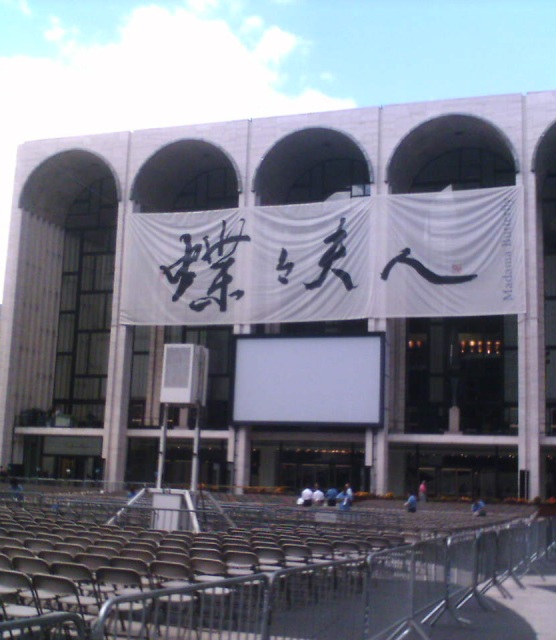
Lincoln Center (Plaza), early afternoon:


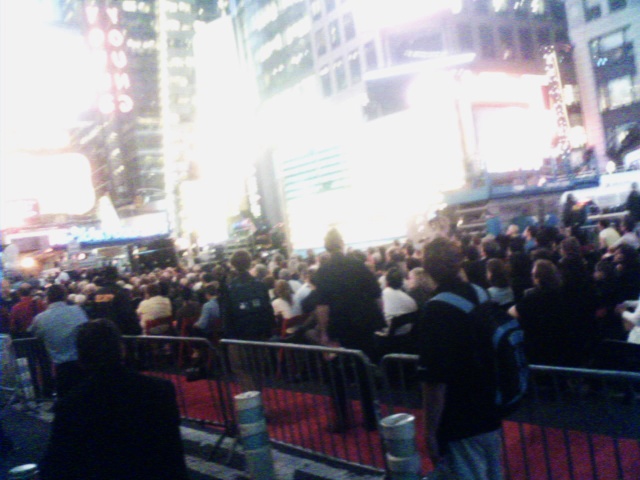
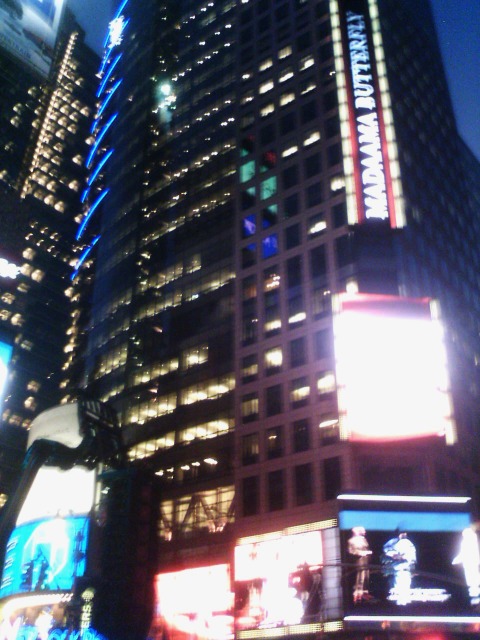
Times Square, early evening:
I had wondered if the live opening night transmission would make any sort of impact in the canyon of Times Square. With Broadway closed off between 7th Ave. and 44th St., its entire 43rd-44th St. block was devoted to viewers' chairs. They were full.
The opera was shown on three screens: (from left to right) Nasdaq, Panasonic, and Reuters. What did we learn? That Panasonic, unsurprisingly, has the best display. But Reuters did provide a neat vertical banner (which scrolled to mention the Met, not just the title here displayed), and production stills on an adjacent, side-facing screen.
What looked like the equipment used in parks concerts was providing sound easily audible even over the Times Square din. Lack of interest in the opera and Cristina Gallardo-Domas kept me from attending the actual performance, but hearing James Levine make Butterfly's entrance music so strongly tell reminded me that I might've considered his return.

On the whole, there seemed to be a real charge among those present, both those seated and the passers-by, who seemed to do even more picture-taking than is the norm in Tourist Central, USA.

*     *     *

Maury should have a report from the house, as perhaps will the remaining New York Wellsung and other bloggers. My Met season begins Thursday, with Levine and Dorothea Röschmann in Idomeneo.

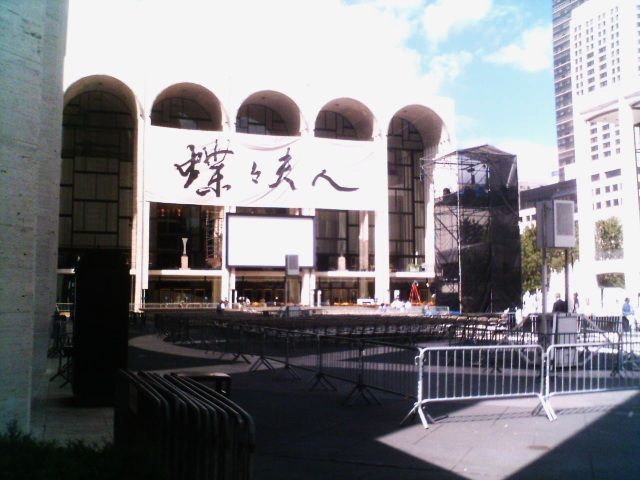
UPDATE (9/26): Via a man with a non-junk camera, Lincoln Center (Plaza), evening.

(And another Times Square report, from the newest New York blogger: Anne-Carolyn Bird, soon to storm the big stage herself. Congratulations on it all.)

And Maury does weigh in, with a "Yes."

Sunday, September 24, 2006

Met radio vs... Met radio

Minnesota Public Radio's blog speculates that the SIRIUS deal may mean the end of the Met's weekly over-the-air broadcasts.

I had thought that the recently-consummated Toll Brothers sponsorship deal was more solid than that, but I could be wrong.

UPDATE: I should check the links in my own prior blog posts.
Joseph Volpe, the Met's general manager, said yesterday that he could not guarantee the broadcasts' survival for more than four years, based on Toll Brothers' initial commitment and other money raised. But he said he hoped the company's support could be extended. "We're relatively secure," he said.
Perhaps less secure now.

The products

I just praised Joseph Volpe for his handling of Met labor issues, so let me begin by saying this: the most significant and groundbreaking event of Peter Gelb's tenure may be the labor agreement he finalized at the beginning of this month.
[T]he Met's orchestra, chorus, ballet and stagehands [...] voted in favor of a new media agreement after extensive negotiations this summer.
In the past, unions have demanded substantial upfront payments to all parties involved in performances -- making recordings, broadcasts and telecasts prohibitively expensive. Gelb calls the new revenue-sharing arrangement a "shift to a more fluid concept of media, in keeping with the infinite possibilities offered by modern technology."
This opens up a huge field for the company and fans alike. No matter how Gelb's specific media and tech initiatives pan out, the labor agreement that enables them is a milestone.

*     *     *

On the heels of this agreement came news of the first concrete initiatives. First, opera-as-movie:
Beginning Dec. 30, the Met will transmit six of its performances live -- with state-of-the-art sound and high-definition imagery -- to movie theaters equipped with special projection systems and satellite dishes throughout the United States, Canada and Europe. After 30 days, the new productions will be presented on PBS stations throughout the country.
Second, something Adam Baer suggested almost three years ago -- live streaming of Met performances (with archival access to follow):
The Met will present live streaming of opera performances on its website with support from RealNetworks®, the leading creator of digital media services. In the coming months, Real will also make the Met's extensive library of radio archive broadcasts available through its award-winning Rhapsody® online music service. Streaming of Met operas is anticipated to begin with the start of the 2006-07 season.
And finally, for the radio-oriented, an entire SIRIUS satellite music channel:
The full-time channel will feature an average of four live broadcasts each week throughout the Met's 2006-07 performance season, with Saturday matinee performances enhanced with live interviews and dynamic intermission programs. The channel will also feature hundreds of re-mastered historic broadcasts culled from the Met's illustrious 75-year history. Additional vocal content will complement the Metropolitan Opera broadcasts.
Note, however, that this will largely largely squash the potential of live webcasts:
Met spokeswoman Sommer Hixson said the company had not yet determined how much overlap there would be between the radio channel and the Internet streaming, which will include at most a weekly performance. The streaming is designed to promote the subscription service.

*     *     *

At first opera was one product, then two (Caruso and the gramophone), then three (radio); now it's -- well, look above. (Actually, the announcements just scratch the surface of what's possible under the new agreement. There's no mention of the inevitable DVD series, for example, that will follow from having six telecasts per season.) Still, it's still only two things at bottom: (1) a laborious and irreproducible live activity founded on human presence, and (2) the technologically mediated and therefore infinitely reproducible and disseminable echoes of that activity.

The latter provides more opportunities for happy consumption to many, many more people, and its expansion is generally praiseworthy. But I think it's essential that Gelb and his "new" media customers remember that the live form of opera is the sine qua non, the golden goose without which there would be few fans, fewer singers, and no basis for the niche demand these secondary products exist to satisfy and encourage.

There's little initial risk of forgetting, as the most excited are hard-core fans who've been dreaming of (and/or illicitly sampling) the Met sound archives' riches for years. When people begin, as they might, discovering the Met through these outlets, though... Will they be well-reminded that, as "real" and large and impressive as a live cinematic rendition might be (or as regular and "live" sounding and voluminous as daily radio may be), it omits huge chunks of the live experience?

That's a thought for the future. For the moment, there's much to enjoy.

Friday, September 22, 2006

Turnover

It was Stendhal, I believe (though I've somewhere lost the ability to verify this), who noted that to make a fortune in business requires something also necessary for writing a successful novel: the ability to see clearly into what is. To these occupations he might have added the successful running of an opera house. Exhibit One: Joe Volpe, whose Metropolitan Opera tenure finally ended this summer.

Volpe in fact stands as a particular example of this virtue, which not only marked his term as General Manager but seems to have been more or less solely responsible for his having attained that position at all. By the plausible account of his autobiography (which is a well-done, interesting work of its kind), it was his easy, baloney-free grasp of the mundane facts of opera -- in an expanding sphere from carpentry to backstage costs to labor negotiations and everything else in the house -- that got him repeatedly promoted from his original job as carpenter. Eventually, Volpe's anointment as "General Director" in 1990 (he became "General Manager" later) followed the short and undistinguished term of the pleasant, socially proper Hugh Southern, who was in a sense Volpe's mirror image. That is: the Met eventually chose -- and recognized the primacy of -- facts. That the house is the largest and perhaps most complicated arts organization in the world precedes and underpins any idealisations or illusions one might have about its role.

Commitment to Volpe paid off in one obvious sense: the Met -- because of a longer season now even more immensely complicated in its operations -- is and has been well-run and financially solid, without serious labor strife, catastrophic shortfalls, or other such outbreaks of widespread chaos. This one would have expected, and is something even most of his detractors will acknowledge. What's less visible is how Volpe's clear seeing extended to the artistic side of the enterprise.

My biggest surprise in reading Volpe's book was discovering how clearly and generally accurately he totes up the triumphs and fiascos among his term's productions. (Fans seem to think of him as sharing Sybil Harrington's crown as Zeffirelli's biggest fan, but one should remember that Volpe -- whose first Met story is of chopping down one of Zef's productions to size -- learned much of his craft working for and with John Dexter.) His belief in Robert Wilson's Lohengrin, for example, has been forcefully vindicated. I wish I had the space and patience to go through the complete reckoning here, but I'll limit myself to this observation: Volpe's instincts in judging which directors should be invited back to the Met were remarkably good. Only Robert Carsen and his unclutteredly poetic production of Onegin get (and got) really unfair short shrift. In the largest matter -- the Ring -- he seems to have picked brilliantly, only to have death take Herbert Wernicke before the production could happen. If Wernicke -- whose Frau ohne Schatten is the clear high-water-mark of the Volpe years -- had gotten four more such productions, how much more luster might this era have?

*     *     *

If there is something that can be said against the man who sees what is, it is that he often is limited in seeing what could be. And it's this element, I suppose, that the board and its supporters think they are getting in Peter Gelb. But we shouldn't forget that Volpe's resistance to the "could be" has done much over the years to preserve the company.

For aside from what each production and each performance and each participant's role is, opera in America, at the Met's scale, has certain inescapable facts to it that one loses track of at one's peril. It is not -- or no longer -- a genteel socialite's timefiller. But neither is it a popular art, nor one about to become so. It is a niche interest, centered in personal presence and highly accountable to its audiences and donors, and as such dependent on the integrity of its brand.

*     *     *

This is not to say that Gelb will not do well, nor that there are no areas for improvement on Volpe's regime. His responses to the post-9/11 drop in attendance, for example, have been sound but unimaginative, and there may well be gains to be had among marginal attendees by, e.g., raising the Met's profile. But under Volpe there was zero chance that the company would do something that would jeopardize its or the art's long-term future here, even when airy popular or elite opinion would have favored it. I hope the same holds true now.

Friday, September 15, 2006

Noted

The first regular production of the city's 2006-07 opera season, City Opera's new Semele (starring Elizabeth Futral), opened Wednesday. Notices have appeared in the Sun, the Times, and the (Newark) Star-Ledger.

Being something of a Futral un-fan, I'd planned to skip the run, but Vivica Genaux, Sanford Sylvan, and a relative minimum of countertenoritis may draw me in nonetheless.

Monday, September 11, 2006

Five years in the new world

Three hundred and sixty-four days a year draw us "on topic", to our niches of work, friends, home, and habit -- the lives we build for ourselves in this elaborate, largely predictable framework that's civilization. But today one can't avoid the abyss over which we've lived for years, which materialized wholly and unmistakably five years ago.

That day's Islamic terrorists rehearsed the gruesome small details to enact the gruesome large ones, in deliberate acts that were no "tragedy" (nor, of course, "art") but mass murder -- crimes, acts of war, abomination -- and a sick fantasy enactment of "martyrdom".


Many cheered -- quite literally -- both abroad and, yes, even in New York.

*     *     *

Those who would enact more such horrors, those who would fund them, and those who would cheer: all still plague us. The next shoe that drops may be worse, much worse. We are neither collectively helpless nor, I think, doomed, but I suspect the natural reflex to avoid looking down at what horrors could be has dulled our true sense of things. And the more likely such horror looks, the stronger that reflex.

Today, however, our mortal danger gets its due. (Except by the deranged.) How it might (again) look. How it might (again) feel. The rupture of every thing and certainty, that may (again) happen. Lest we forget...

It will be a long road before we can afford to, even for a while.


UPDATE: The last embedded video I had put up seems to be overloaded, so I've unembedded it for now. It can be found here when the server recovers.

Tuesday, September 05, 2006

The slow reunion

While greats of old continue passing, the New York season begins its beginning this week with some festive City Opera preliminaries. Some point soon, the metacommunity of the city's music audience will have reconstituted itself from near and far, as if it had never been dissolved. But it was -- any summer event here may as well have been in a different city altogether.

As for myself, I've not had a happy or productive summer for as long as I can remember. This one was no exception: good riddance!

But I welcome you all as you file in for the third season of An Unamplified Voice, scheduled to kick off very soon.

Monday, August 14, 2006

Old defaced torso

Perhaps it was the venue. I'm not sure what sorts of events the Time Warner Center's ugly and hard-to-access Rose Theater usually hosts, but the last "operatic" event there turned out to be a disappointing pop cultural melange.

Then again, I now recall that it was Peter Sellars who directed the Golijov piece, as well as the presentation of Mozart's (unfinished) Zaïde seen last Friday. But he and Golijov are a natural couple. Mozart, not so much.

The most obvious thing about the Zaide fragment is that it's, well, fragmentary. The piece lacks an ending, but more jarring in performance is the absence of any dialog linking the numbers of this singspiel. Sellars adds no dialog -- skeletal, updated, or otherwise, though he does interpolate a few numbers from another Mozart fragment (Thanos, King of Egypt). Instead he has the performers crudely pantomime in the grossest stereotypes: Gomatz as prison bitch, Osmin as a fried-chicken-eating hood, Allazim as the magic negro, and Zaide herself as a submissive-then-shrill Chinatown FOB (her actual costume being rather more loaded than that shown in the PlaybillArts link above). These latter depictions crossed, I think, the line into racism, but perhaps more offensive was how insultingly stupid they all were in light of Mozart's musical characterizations. Only Soliman was allowed some variety of poses -- none subtle.

These were intentional choices, and show Sellars and Mozart working at cross purposes. Sellars, as with the Golijov piece, tries to heighten the populist sense of the piece by flattening out individual aspects of the characters, leaving them more symbols of oppression and victimization. So Gomatz, with nothing to say, has no personality and is merely (and purely) pathetic; while Zaide herself -- whose music threatens to open spaces of expressive and human variety -- is otherwise straitjacketed in strict stereotype.

Now it's true that Mozart's form for Zaide -- a vernacular rescue opera employing not comedy but (at times) melodrama -- invites a certain amount of popularizing and cartoon-izing. (One sees it even in Fidelio, in the mustache-twirling aspect of Pizarro that's difficult to take seriously.) But nothing in Mozart is as inhumanly didactic as Sellars would make this piece; the personal and individual foibles of the suffering always get space. (And perhaps he abandoned Zaide for its inflexibility on this point. The comic angle of the later Entführung provides more possibilities.)

*     *     *

I regret, in part, compounding the Mostly Mozart Festival's error in headlining Sellars' contribution to the show. That he made himself the story with a harmful staging was part of the evening, but could hardly be the whole in a Mozart evening. But the musical haul was itself mixed. Festival music director Louis Langrée led the period group Concerto Köln in a viscerally exciting account of both Zaide and the Thanos excerpts. This seemed to play to their strengths as an ensemble, while being of a piece with the popularizing tone of the production. But excitement worked against tenor Russell Thomas (the Soliman -- whom, incidentally, the Sun's Fred Kirshnit misidentified as a bass-baritone): usually precise as well as fascinatingly intense, he'd apparently been encouraged to sacrifice much of the former for a bit more of the latter. Still, I hope to hear him in more leads soon. The best singer on the night was bass-baritone Alfred Walker (as Allazim), whose rich dark tone was the event's main pleasure. The others, unfortunately, made little vocal impression.

Is Zaide an overlooked masterpiece? It's hard to say. The piece is best known for Zaide's arias, but Korean/American soprano Hyunah Yu (the only non-black singer in the cast, by bizarre intention) didn't -- or wasn't allowed to -- make much of them. As for the rest, the lack of dialog threw off the pacing of the work as a whole, which actually seemed much longer than it would have with some intervening talk. And I admit being unable to ignore a particularly bad or offensive staging. So -- ask me again, after a better-realized concert version.

*     *     *

The veneer of contemporary commentary is too silly and tiresome to discuss. But it -- as laid out at length in synopsis and program notes -- shows that Sellars would've had no problem adding dialog, if he'd so chosen.

Friday, August 04, 2006

A era or two ago

Does the death of Elisabeth Schwarzkopf have, as Maury suggests, some of the passing of an era in it? Not, surely, that sonic era of postwar Vienna (which, if it survives as a person, has been near Bern for ages). Schwarzkopf's virtues were not theirs.

Perhaps her phenomenon (as opposed to her work itself, which one could hear and see and is more or less representatively preserved for current judgment) is most interesting as a sort of high-tide for the critic, particularly the London variety. Presence and looks she had, for sure, but these alone did not make hers a name to which one could safely attach any praise or expect non-musical people to recognize, nor let, e.g., her hilariously misjudged Schubert disc be taken seriously.

But that's probably a step more than is necessary: was she not simply the first ubiquitous singer of the LP era, as Pavarotti and Domingo have been in CD times? Ah, the days when people believed in studio recordings!

She was neither the last, nor the greatest, but she was for a while the most praised. That is something.

Friday, July 21, 2006

As promised

As video appendix to previous commentary on the Volpe Gala, its defining moment:


Natalie Dessay (and Elaine Douvas, et al.) in Bellini's Sonnambula finale. The set -- of which she actually makes brilliant use -- is from Act I of Zeffirelli's Traviata production.

A blogger in performance

Lower Manhattan's River to River Festival will present baritone and blogger Tom Meglioranza in a free recital this coming Monday at Pace. Having heard him last summer at the Naumburg finals, I think this event should be interesting -- worth attending.

Wednesday, July 19, 2006

In case you were wondering...

I make no claims to being any sort of "superlistener".

(But I am -- to go off-topic -- a longtime Matt Kramer fan.)

Thursday, July 13, 2006

The show must go on

A week after Lorraine Hunt Lieberson's shocking-if-unsurprising passing, online talk has already bubbled up about her possible replacement in next season's Met/Mark Morris Orfeo. With Hunt, it was the most anticipated event of the coming season. Now -- as it's probably impractical and definitely unwise to cancel the production -- things are up in the air. There's no official word (or strong rumor) on a substitute, just speculation.

From a purely vocal standpoint, I wonder if the house could do better than one of its own youngsters. I'd never thought I'd hear a sound like Kathleen Ferrier's, but Tamara Mumford's lower register has some of that great Orfeo's uncanny contralto timbre. Even more remarkable, I think -- and again recalling Ferrier -- is the pure, unforced seriousness of the young mezzo's natural manner. It's too bad opera has few leading parts for such a combination.

But I suspect it's unlikely that the Met would entrust a new, high-profile production to a twentysomething-year-old third-year Lindemann singer, no matter how talented. So if it's to be a "name" star, I'd like to see Vesselina Kasarova -- an excellent singer who hasn't yet been shown in her element in New York.

Naturally, I'm sure Peter Gelb et al. have their own ideas.


UPDATE (7/19): Via a helpful commenter, the replacement seems to be David Daniels. Those who've read the archives may recall that I consider the countertenor-in-old-repertoire phenomenon essentially fraudulent, and Daniels -- whose voice sits far too high for these parts -- doubly so. I've no doubt this choice will sell tickets, but what an artistic waste.